Keep Victoria Falls Wild
The Victoria Falls - A Natural Wonder
Ecology of the Victoria Falls Region
The Zambezi Biome
Ecology of the Victoria Falls Region
Ecology of the Upper Zambezi Basin
Flora
Mammals
Birds
Reptiles and Amphibians
Fish
Invertebrates
Conservation Significance
Ecology of the Victoria Falls Region
The Zambezi Biome
The Zambezi basin is dominated by a characteristic ecology known as the Zambezi Biome.
"The Zambezian biome covers the great majority of the basin, around 95%, and comprises woodland, grassland, swamp and lakes. The climate is strongly seasonal with a marked dry season. Frost often occurs on flat ground on the plateau. This biome is sometimes subdivided into moister areas with miombo broad-leaved woodland, and drier areas with mopane or Acacia woodland." (Timberlake, 2000)
Small areas of the Congolian biome occur in the Zambezi headwaters.
"The Congolian biome are found associated with the headwaters of the Zambezi in northwestern Zambia and northeastern Angola with a moister and warmer climate than that of the rest of the plateau portion of the basin. Here the vegetation and species are a mix of those found in the forested Congo Basin and those found in the less tropical, more wooded, Zambezi Basin." (Timberlake, 2000)
"In terms of broad vegetation types, almost half of the basin is classified by White as wetter or drier miombo woodland, part of the Zambezian biome. Miombo is a type of woodland dominated by trees of the genera Brachystegia, Julbernardia or Isoberlinia with a welldeveloped grass layer. Other widespread vegetation types are mopane woodland (dominated by mopane, Colophospermum mopane), mosaics of various types of woodland, dry forest (including that dominated by Zambezi teak, Baikiaea plurijuga) with grassland, and open woodland dominated by various species of Acacia...
"Both miombo and mopane woodland are not particularly species-rich, nor do they contain many species of restricted distribution." (Timberlake, 2000)
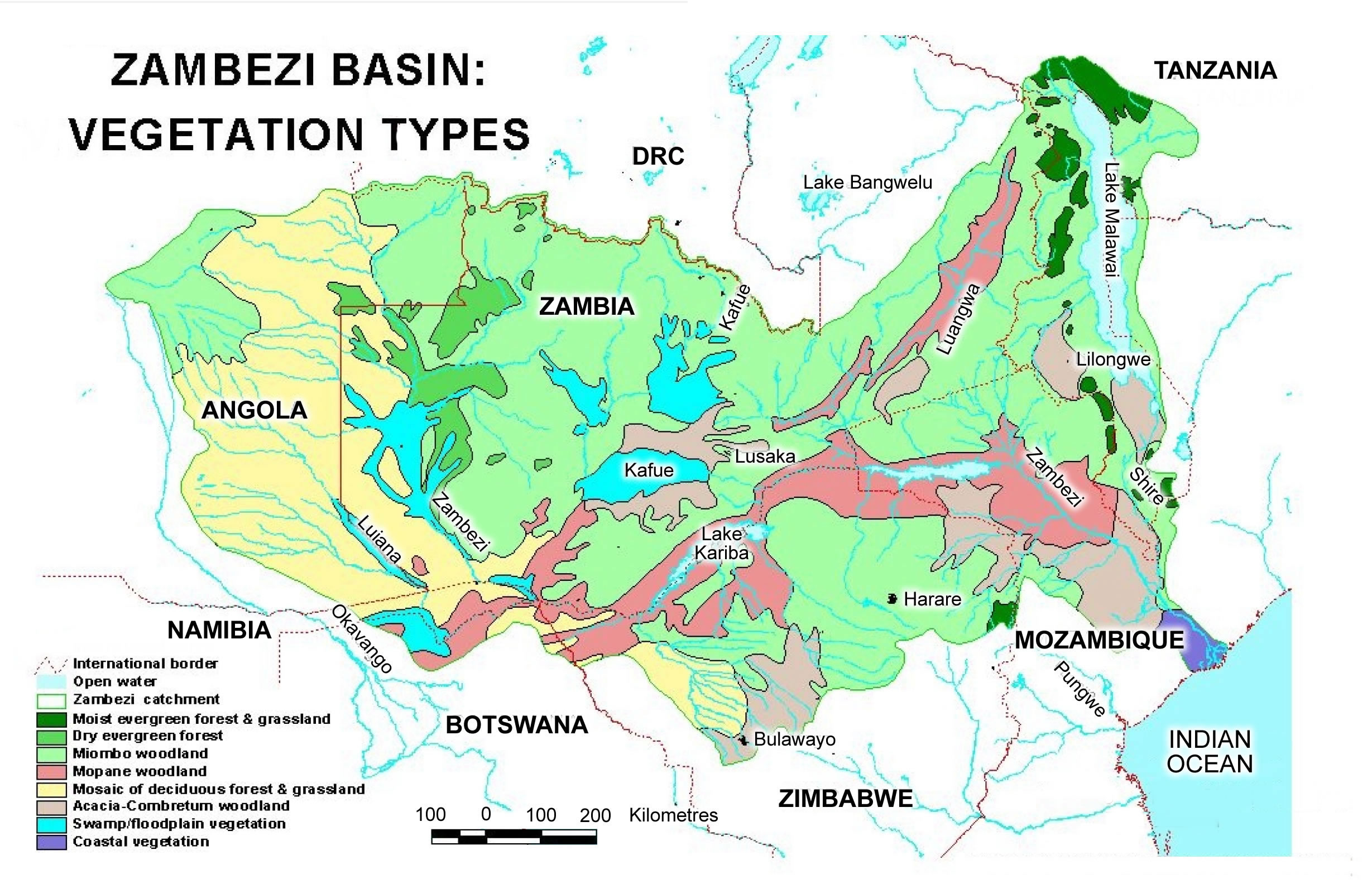
The Zambezi River Basin Vegetation Types (Timberlake, 2000e)
[click image for larger view]
Ecology of the Victoria Falls Region
The ecological and conservation significance of wider transboundary area was reviewed by the Four Corners Transboundary Natural Resources Management Area (TBNRMA) Initiative in 2004, part of studies which led to the foundation of the Kavango-Zambezi Transfrontier Conservation Area (KAZA TFCA) in 2006. The initiative, implemented by the African Wildlife Foundation (AWF) in collaboration with various regional partners, included the Chobe, Hwange, Mosi-Oa-Tunya/Victoria Falls and Caprivi areas.
The study area covered by the technical review did not include the Barotse floodplains or Kafue FLats, already covered by similar reviews produced under the IUCN Zambezi Basin Wetlands Project (Timberlake 2000),
"Covering over 322,000 km2 of the continental plateau of south central Africa, the Four Corners area includes the south east corner of Angola, the Caprivi Strip in Namibia east of the Kavango River, and the Okavango Delta and Makgadikgadi pans in Botswana. In north west Zimbabwe it includes northern Tsholotsho communal land and areas north and east to the Gwayi River, while in Zambia it covers the south west Zambia corner north to Senanga. All of the Kafue National Park is included, but not the Kafue Flats."
Protected lands within it include the Hwange, Victoria Falls and Zambezi National Parks in Zimbabwe; the southern part of Kafue National Park, the Mosi-Oa-Tunya and Sioma Ngwezi National Parks in Zambia; and the Chobe National Park and Moremi Wildlife Reserve in Botswana, the Mudumo, Mamili and Bwabwata National Parks in Namibia. These cover an estimated 115,953 km2.
"Geographically, the area is centred around the point where a number of major southward-draining rivers joined in the past, forming the palaeo-Upper Zambezi river (Moore, Chapter 2). Much of the drainage from a vast swathe of the plateau passed through here around 0.5-1 million years ago, forming a number of large lakes now only discernible by the presence of extensive calcareous lacustrine deposits. Virtually the entire area is now covered in a mantle of windblown Kalahari sands of varying depth. There is only a limited extent of outcropping bedrock - principally basalt and Karoo sandstone in the Matetsi/Victoria Falls area." (Timberlake & Childes, 2004a)
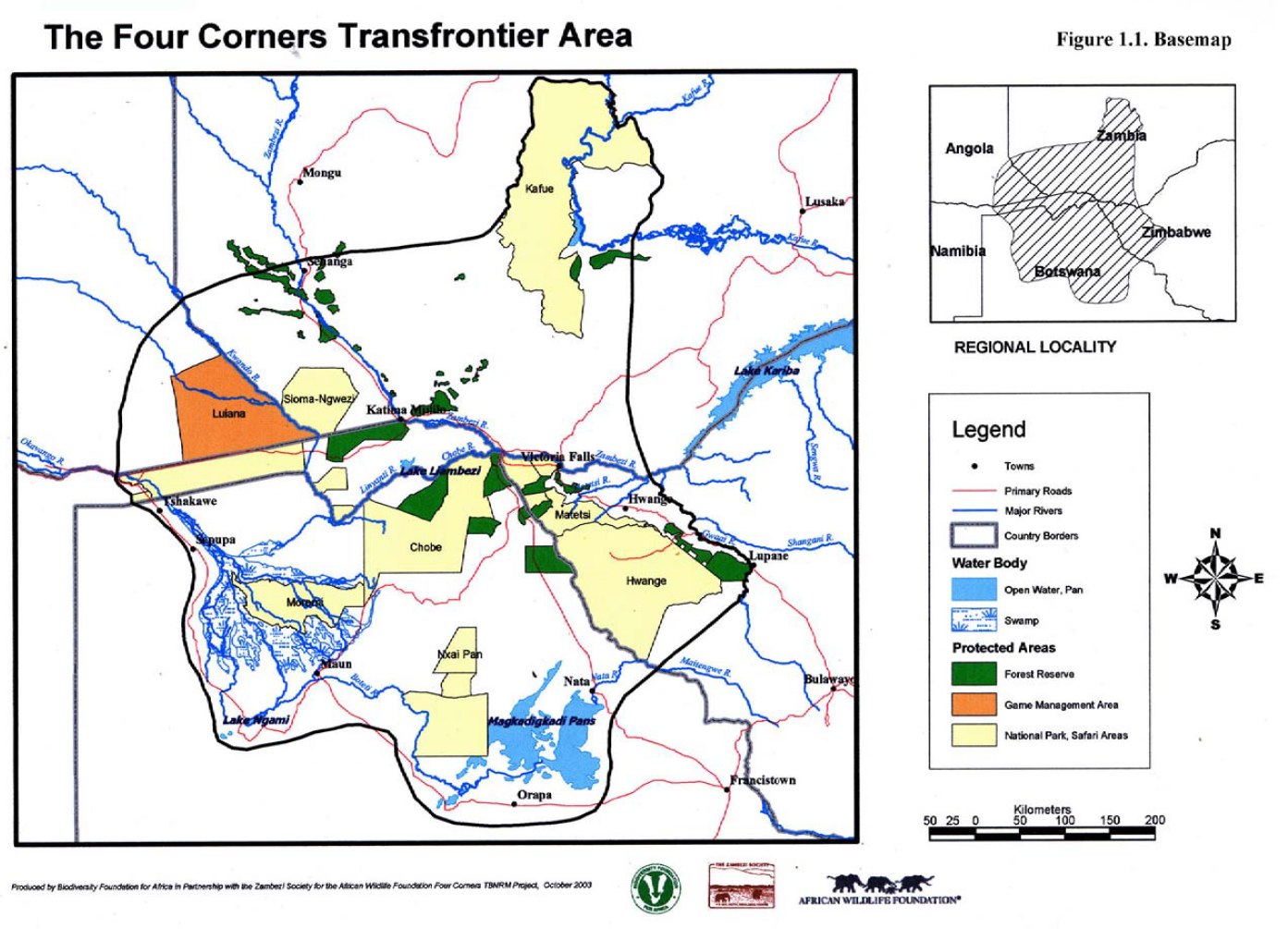
The 'Four Corners' study area (Timberlake & Childes, 2004a)
[click image for larger view]
"A number of unifying features of climate, geology and topography characterise the area:
" - a continental interior location, within an narrow altitude range of ~ 900 to 1200 m;
" - a savanna climate, with a dry season of 5-8 months;
" - a rainfall gradient, from around 900 mm mean annual rainfall in the north to about 400 mm in the south;
" - evapotranspiration rates that increase from north to south and exceed rainfall in all months;
" - occasional severe winter frosts, increasing in frequency and severity to the south; and
" - a mineral-poor surface geology consisting of Kalahari sands or deeply weathered basement rocks, with occasional exposures of mineral-rich rocks.
"One of the area's key biological attributes is that it is a meeting place for the biodiversity of the old Upper Zambezi system with that of the Kalahari and younger rejuvenated Middle Zambezi drainage system. The lower-lying, non-plateau parts have been environmentally unstable for the last million or more years owing to radical changes in hydrology, and the composition of both flora and fauna reflect this in their distributions.
"The most significant feature of the Four Corners area is the large drainage system running through it (the Zambezi, Kavango/ Okavango, Kwando and Chobe rivers) linked by grasslands, ribbons of riparian woodland, and in places, a high density of seasonal pans. The 'core' is a series of wetlands (Okavango, Chobe/Zambezi) and saline lakes (the Makgadikgadi Pans). Surrounding these wetlands are various types of woodland, dominated by species such as mopane, Brachystegia, Acacia and, especially, by the Zambezi Teak Baikiaea plurijuga. Another major linking biological feature is the presence of significant populations of the African Elephant Loxodonta africana. The area is thought to contain upwards of 178,000 individuals, or around 30% of the world's estimated population of this charismatic megaherbivore." (Timberlake & Childes, 2004a)
Ecology of the Upper Zambezi Basin
Timberlake and Childes gave a concise summary of the ecology of the Upper Zambezi as part of preliminary reports on the transfrontier area in 1998:
"This upper part of the Zambezi Basin typically comprises a series of broad floodplains separated by low sand plateaux, all set in a comparatively old, flat landscape. Swamps are scattered and generally small. The area is overlain by Kalahari sands with very little outcropping rock." (Timberlake, 1998)
"The character of the initial section, from Mwinilunga to Cazombo in Angola, is of tall dense miombo woodland, rich in species with affinities to the moister Congo Basin. Swamp and gallery riverine forests are common. The flat nature of the landscape along the watershed has allowed some water-dependent species to move from one catchment to the other. After flowing south-west, the Zambezi turns due south downstream of Cazombo. And it is from here that the very extensive grassland areas, by far the largest expanse of natural grassland in the whole Zambezi Basin, start. These encompass most of the western tributaries all the way to the Cunene River and the Caprivi.
"Downstream of the Angolan border in Barotseland, the river becomes larger and more consolidated, forming a series of floodplains which flood annually. Habitats are generally broad, and species composition changes to reflect the lower rainfall and less tropical conditions. South of Senanga, where the river turns to the south east, the floodplain abruptly narrows. The river is more channelled and flanked by plateaux of Kalahari sand covered in extensive semi-evergreen woodland, which typically support species of economic value such as Baikiaea plurijuga and Pterocarpus angolensis. The extent of wetland is much reduced and is confined primarily to dambo-type grasslands along the larger tributaries. In some areas pans are common.
"At Katima Mulilo the Zambezi turns markedly to the east, and broad floodplains are again found all the way to Kazungula where it joins the Chobe River. This section has been the meeting place of various river systems - the Kafue, the Kwando and the Upper Zambezi - and was once the site of a large inland lake, Lake Caprivi, thousands of years ago. The Kwando River (in Angola, the Cuando), rising in the highlands of central Angola, flows southward into the Caprivi not far from Katima Mulilo, then forms a series of swamps - the Linyanti Swamps - along the border with Botswana. Downstream, the Kwando-Linyanti flows east towards the Chobe River, meeting it at the now dried-up Lake Liambezi. It is difficult to draw a distinction between the Kwando, Linyanti and Chobe rivers, and the Chobe is also characterised by bidirectional flow, depending on water levels and flooding from the main Zambezi.
"From Kazungula to Victoria Falls the river is broad but without marked floodplains, flanked by dense, deciduous woodlands on Kalahari sand. At Katombora the Zambezi starts to cut into the underlying Karoo basalts, and then goes on to form the famous Victoria Falls 60 km downstream. Here it changes its character from a broad, slow river into a fast confined one. Its biology and associated fauna also change dramatically – the Falls are perhaps the main biogeographical barrier or disjunction of the whole basin." (Timberlake, 1998)
"The Upper Zambezi floodplains, roughly from the Zambezi-Luena confluence in north east Angola down to Livingstone/Victoria Falls, have received a surprisingly limited amount of biological attention, which has principally been in the form of broad biological surveys and checklists. The main groups covered have been plants (checklists), large mammals (lists, taxonomy, conservation, surveys, census), birds (lists, surveys, conservation), reptiles and amphibians (checklists, taxonomy, biogeography), fish (checklists, biogeography, ecology of a few individual species, fisheries) and dragonflies (taxonomy, checklists, biogeography). The large distances and general inaccessibility of much of the area owing to seasonal flooding have probably been major limitations to more detailed work." (Timberlake, 1998)
Flora
The area has a moderately rich flora in terms of floral diversity with 2,645 species recorded. It supports a mixture of species characteristic of dry Kalahari, miombo and similar woodlands, as well as wetlands, and many are adapted to nutrient-poor soils and periodic fire.
"As most of the area lies on nutrient-poor Kalahari sands, the vegetation is also primarily nutrientpoor, lacking in both phosphate and nitrate. Where these nutrients are more common, such as around termite mounds, in riparian woodland, or associated with outcrops of rocks such as basalt, forage quality is better, and such areas become nutrient "hot spots" for animals as well as supporting a different set of plant species. The continued diversity of the landscape, with hot spots in a matrix of nutrient-poor woodlands and grasslands, is what must be maintained if the present high levels of biodiversity are to be kept. It is the patchwork of habitats - primarily due to differences in soil moisture and nutrient content - that leads to high biodiversity. Of particular importance in this regard are riparian woodlands, the woodland-grassland zones where dambo or vlei grasslands form a network within broadleaved woodland, and (especially for birds) the pans.
"Apart from herbivory, the other major ecological factor is fire. Woodland and grasslands in the area are adapted to fire; indeed they have evolved with it. But its frequency is now much higher than in the historical past, and fire-tolerant species are starting to predominate at the expense of the fire-sensitive ones. These effects are compounded by frost - not uncommon on the Kalahari sands - which has greater impact on vegetation once the tree canopy is opened up. Fire and frost, now coupled with the impacts of elephant, can cause woody vegetation to be "trapped" at a coppice shrub stage, and inhibit regeneration of closed canopy woodland. This is one of the main conservation concerns for the Four Corners area." (Timberlake & Childes, 2004a)
The region is dominated by various characteristic types of woodland (Baikiaea, miombo, mopane, Acacia), grassland and wetlands.
"Four main structural vegetation types are recognised in the Four Corners area: dry forest (Cryptosepalum) which is very localised in the north; various types of woodland (Baikiaea, miombo, mopane, Acacia) that cover by far the greatest portion of the area; grassland; and wetland. These form a mosaic over much of the area at varying scales. It is the juxtaposition of these types - their mosaic nature - that gives rise to the area's moderately high biodiversity, and greatly facilitates animal movement between habitats."
"Perhaps the most important woodland type from a conservation perspective is that dominated by Baikiaea plurijuga, a type restricted to this part of south central Africa. The Four Corners area contains almost half of its total extent. Woodland dominated by Colophospermum mopane is also significant in terms of extent and ecological importance, while true miombo woodland (dominated by species of Brachystegia) is of much lesser extent. Wetland vegetation is of major importance, running through the area following the main rivers, and creates not only much of the diversity but is also the source of the uniqueness of the Four Corners area. The saline grasslands of the Makgadikgadi pans and other smaller pan systems, are unique." (Timberlake & Childes, 2004a)
Read more on the Flora of the Victoria Falls Area.
Mammals
The region is well known for its large mammal populations, including elephant, buffalo, zebra and a diversity of anetlope species.
"The Four Corners area has arguably one of the richest mammalian assemblages in southern Africa, with a full complement of both herbivores and carnivores so that natural predator/prey cycles can still occur. In addition, it supports around 30% of Africa's estimated elephant population. One of the major reasons is the high proportion of formally protected land in the form of national parks or similar areas. Of particular interest is the wide range of antelope species, reflecting the extent and variety of grasslands. The upper reaches of the Zambezi - a mosaic of grassland, wetland and woodland - have been an area of evolutionary radiation for a number of ungulate species over the last few million years, notably lechwe antelope. However, habitat fragmentation and disruption of historical movements is now threatening this diversity.
"From an evolutionary perspective, what is also interesting is the sympatry (populations of similar species living in the same or adjacent areas) of the Spotted-necked and Clawless otters on the Upper Zambezi River, and of three subspecies of Burchell's zebra in north east Botswana. Other species, e.g. puku, waterbuck, lechwe, are at the limits of their distribution here. The major gaps in our knowledge of the group are species presence, and the distribution and ecological function of such small mammals as shrews, rodents and bats." (Timberlake & Childes, 2004a)
The study area hosts no known endemic large mammal species, with the region's only endemic species, the Kafue Lechwe, not occuring within the area.
"Out of the 197 species listed as occurring, none is endemic to the Four Corners area, and 10 are considered threatened. These include the Spotted-necked otter, Painted hunting dog, lion, cheetah, black rhino and, ironically, the African savanna elephant. The Kafue lechwe, endemic to the Kafue Flats, is now not found inside the study area. Along with the Painted hunting dog and the charismatic and ecologically important elephant, the Puku is also considered an important 'flagship' species for the Four Corners area and is confined here to a small population on the Chobe floodplain.
"Historically, large mammal populations have been severely affected by hunting, commercial poaching, and animal diseases such as rinderpest. Over the last 10-20 years rhino have been heavily poached such that they are now critically endangered, and yet the elephant population has been increasing annually at almost 6% - close to its biological maximum.
"Some large mammal populations, such as buffalo, zebra and elephant, move across the landscape seasonally, seeking water and forage. These movements often cross international borders and a harmonised transfrontier approach to their management and conservation is required." (Timberlake & Childes, 2004a)
There is a lack of knowledge on the region's smaller mammal species.
"There are an indeterminable number of species of small mammals (especially shrews and bats) the occurrence of which is based on very sparse data." (Timberlake & Childes, 2004f)
"The mammal fauna comprises at least 197 species, the majority of which (145 species, or 74%) are small-bodied (less than 10 kg in mass). The largest groups are rodents (47 species), bats (53 species) and insectivores (9 shrews and one hedgehog), which comprise 56% of the total for the area." (Timberlake & Childes, 2004f)
Birds
The avifauna of the region is generally well recorded and studied, with over 600 species known from the study area.
"Many birds are charismatic and often highly mobile, hence our knowledge on them as a group is probably better than for any other. Bird checklists and atlases are available for much of the area, although our knowledge of the avifauna of south east Angola is minimal. Of the 601 recorded species from the Four Corners area - a moderately rich avifauna - 524 are known to breed here.
"There are 76 palaearctic migrants (species that migrate annually from the northern hemisphere during their winter period, but do not breed in the south) and an additional 52 intra-African migrants. Many reside for a number of months in wetlands, pans or floodplains, while others wander at will over grasslands and thornveld. These species know no boundaries, again showing the importance of a transfrontier approach to conservation.
"Important habitats for birds are (a) grasslands, which are a centre for speciation for some genera, (b) wetlands, in particular the Okavango swamps, and (c) pans, particularly for waterfowl. For example, the Okavango has 450 recorded species, and the Makgadikgadi is one of only two breeding sites for the Lesser Flamingo in southern Africa. The Lesser Flamingo, Wattled Crane and African Skimmer are identified as charismatic flagship species for the conservation of the Makgadikgadi pans, Okavango and Zambezi sandbanks, respectively. A splendid diversity of 60 species of raptors is listed, of which 36 have been recorded in the Batoka gorges.
"There are 17 bird species of global conservation interest, of which six are of particular importance (Slaty Egret, Wattled Crane, Lesser Flamingo, Black-cheeked Lovebird, Taita Falcon, African Skimmer). Two of these, Slaty Egret and Black-cheeked Lovebird, are virtually endemic to the Four Corners area.
"Ornithologists have identified 12 Important Bird Areas within the Four Corners using rigorous numerical and distribution criteria. Some of these are rather small (e.g. Lake Ngami and Batoka Gorge, each 100-250 km2), whilst others are very large (e.g. the Okavango swamps, Kafue and Hwange National Parks)." (Timberlake & Childes, 2004a)
Reptiles and Amphibians
The region contains a rich reptile and amphibian species diversity, including several near-endemic or endemic species of reptile and three endemic frog species.
"As with plants, the Four Corners area is a meeting place of the reptilian and amphibian fauna from the Kalahari, the Upper Zambezi, and from the broad-leaved woodlands of Central Africa. There are 128 species of reptile and 50 species of amphibian recorded. Owing to the often sandy soils, burrowing or fossorial reptiles are comparatively common as they can more readily dig and their invertebrate food source is more frequent. As such animals cannot cross large perennial water bodies such as the Zambezi River, speciation occurs more readily.
"Out of the 178 species recorded there are five endemic or near-endemic reptiles: Spiny agama (Agama makarikarica), Tsodilo gecko (Pachydactylus tsodiloensis), Long-tailed worm-lizard (Dalophia longicauda), Barotse water snake (Crotaphopeltis barotseensis), Okavango hinged terrapin (Pelusios bechuanicus) and three endemic frogs - the Reed frogs (Hyperolius aposematicus, Hyperolius rhodesianus) and the Grass-frog (Ptychadena mapacha), a comparatively high figure given the size of the area and its cosmopolitan assemblage. But only the gecko, snake and frogs appear to be threatened. Of the areas of particular conservation interest only the Eastern Caprivi, with its very rich fossorial reptile fauna, lies clearly within the Four Corners area. The Nile Crocodile is a major predator in aquatic ecosystems. As with other taxonomic groups, the gaps in our knowledge are the distribution and status of many species, particularly in Angola and south west Zambia." (Timberlake & Childes, 2004a)
Fish
Representing the lower half of the Upper Zambezi catchment area, the study area is part of a wider wetland ecosystem with a diversity of species.
"It is not very useful to separate the fish fauna of the Four Corners area from that of the upper reaches of the Kavango and Zambezi rivers. In fact, many of the species of conservation interest in these systems are found upstream of the study area, and others use the upper reaches as spawning grounds. The fauna is a mixture of Upper Zambezi elements from slow, sluggish rivers and floodplains, and Middle Zambezi elements from younger 'high energy' rivers. Ecologically diverse as far as fish are concerned, as well as being biogeographically varied, there are 109 species recorded from the Four Corners area, and another 26 in the Zambezi and Kavango headwaters or immediately downstream. Tigerfish is the main predator; the relative abundance of fish species reflects their distribution. Habitats of particular interest are floodplains, which are very important for fish breeding, and fast-moving rivers with a rocky substrate. The latter in particular are under threat from dam construction.
"There is one endemic killifish (Nothobranchius sp.) found in pans in the East Caprivi, and one other globally threatened species, Phongolo suckermouth (Chiloglanis emarginatus), in a tributary of the Gwayi River. Other endemics or species of particular interest are found just outside the Four Corners area in the Upper Zambezi or Kafue rivers.
"Changes in hydrology resulting from dam and barrage construction, particularly on the Kavango and Zambezi rivers (Victoria Falls, Batoka gorge), is the major conservation issue, along with water abstraction schemes. Pollution and sedimentation are not significant at present, but could become so. Another major concern is the introduction and spread of alien invasive fish species such as Nile tilapia (Oreochromis niloticus), an escapee from aquaculture schemes, and the introduction of Sharptooth catfish (Clarias gariepinus) into pans or small water bodies. The aquatic weeds water hyacinth (Eichhornia) and Kariba weed (Salvinia) give rise to problems on large water bodies, but are now largely manageable using insects as biological control agents.
"Fisheries are a major source of rural livelihoods in the area; much attention needs to be given to ensuring yields are sustainable yet retaining fish diversity. There is a need for better fisheries survey and management, and monitoring of fish stocks should be an important future TFCA activity." (Timberlake & Childes, 2004a)
Biological composition differs greatly between the Upper and Middle/Lower sections, and is thought to be a result of comparatively recent river capture of the proto-Upper Zambezi (which originally included the Bangweulu swamps, Kafue, Kavango and Okavango) by the more recent Middle Zambezi (Timberlake, 1998).
Invertebrates
The Four Corners review studies focussed on Butterfliers (Lepidoptera) and soil invertebrates and ecology.
"Reviews on invertebrates cover the well-known butterflies and the much more poorly known soil fauna (particularly termites) and aquatic invertebrates. The latter two groups, although functional rather than taxonomic, were chosen as both are very important for the ecological functioning of the area, and our knowledge of them has not been reviewed before.
"Among very many invertebrate groups, only the butterflies (one group of several families within the Lepidoptera) are particularly well-known. There are significant data on the distribution and diversity of Odonata (dragonflies and damselflies), but these are not reviewed here having been well covered by Fitzpatrick in the IUCN Zambezi Basin Wetlands Biodiversity study (see Timberlake 2000). Of the almost 300 butterfly species recorded, most are found in Zambia and Zimbabwe; Angola is poorly known. Wetlands and moist riparian woodland are the most important habitats, with some species (including one near-endemic form) confined to the Victoria Falls 'rainforest'.
"There are strong links between species distributions and vegetation type. Eighteen species of interest have been identified from the area, including two near-endemic subspecies, (Modest Bar, Cigaritis modestus modestus and Fiery Acraea Acraea acrita ambigua) and one endemic species (Norman’s Copper Erikssonia alaponoxa) known only from miombo woodland near Kataba in SW Zambia. The latter is also considered threatened. The Broadbordered Acraea, a form of Acraea anemosa (forma alboradiata) is known only from the Victoria Falls rainforest. The major threats to butterflies are habitat destruction, particularly to riparian and similar well-developed woodlands, either by clearance or by elephant.
"For both soil fauna and aquatic invertebrates it is not possible to draw up species lists or look at the groups at a species level - our knowledge is just too poor to do anything but look at family or higher levels. The lack of specialists who can identify these organisms is a major constraint and concern. Soil fauna, particularly termites, play a major role in nutrient dynamics and decomposition, soil formation and structure in terrestrial ecosystems, while aquatic invertebrates play a similar role in aquatic systems.
"Although forming a significant proportion of invertebrate diversity, only around 5% of soil fauna has been formally described. Up to 30 Orders of soil invertebrates and many thousands of species may be present in a single habitat. There is a high patchiness in distribution, and most species are affected by changes in moisture and temperature regimes. Recent research in terrestrial ecosystems has shown a possible 10 times decline in abundance and biomass of soil fauna when natural woodland is converted to arable land, or when canopy trees are felled.
"For aquatic invertebrates, the most threatened habitat within the Four Corners area is fastflowing rivers over rock as rocky substrates can be adversely changed through siltation. Pans and pools are also important habitats. Substrate and flow regime are important determinants of species composition. The group as a whole is very useful for monitoring of water quality by comparing proportions of functional groups, and there is a need within the TFCA to establish monitoring sites for this. There are concerns over possible changes in composition owing to pollution from insecticides (such as DDT), industry and urban settlements, although these are not yet apparent." (Timberlake & Childes, 2004a)
Conservation Significance
The river corridor above and below the Falls were identified within the study area as being among eight areas of high plant biodiversity and conservation interest, including the Okavango swamps, three areas of riparian fringe along the Kavango/Okavango and Zambezi rivers, river gorges below Victoria Falls, Makgadikgadi pans, Kazuma pan, and dunes and mudflats around southern Hwange National Park.
"Zambezi riparian woodland between Kazungula and Victoria Falls: An area of what was well-developed riparian woodland with a rich assemblage of plant, mammal and bird species. The woodlands contain a number of rare woody species of very restricted distribution, and are also important for butterflies. However, much has been cleared on the Zambian side for agriculture and settlement. On the Zimbabwe side, although protected as the Zambezi National Park and Matetsi Safari Area, it has been heavily impacted by elephants; what was closed woodland has been opened up quite rapidly over much of its extent. Very unusual stands of Floodplain Acacia Acacia kirkii are found on mud flats at Kazungula and elsewhere dating from Pleistocene times, but have also been almost destroyed by elephants.
"Victoria Falls and Batoka Gorge: The Zambezi abruptly changes its nature here from a wide, relatively sluggish river with many wooded islands to a narrow rushing river enclosed in a 100 m deep gorge carved into the basalt. The permanent spray zone at Victoria Falls, in both Zambia and Zimbabwe, allows for the development of mesic woodland and herbaceous vegetation with a number of unusual plants. The 'rainforest', essentially an extensive riparian forest caused by the permanent spray from the waterfalls, contains plant species which are localised in distribution or outlying populations. The Batoka gorge contains four endemic plants, and is important for birds such as the Taita Falcon and raptors (36 species identified). The gorges are mostly unprotected, although generally inaccessible. The Batoka Gorge dam, if built, will flood much of the bottom of the gorges and change the microclimate. The Victoria Falls area is protected on both the Zambian and Zimbabwe sides, although it is heavily utilised by visitors. Invasive plants such as Lantana camara are now a problem." (Timberlake & Childes, 2004a)
References
Links to external sites or pdf downloads, open in a new window.
Timberlake, J.R. (1998) IUCN Zambezi Basin Wetlands Report, Phase 1. Occasional Publications in Biodiversity No.3. BFA, Bulawayo/Zambezi Society, Harare.
Timberlake, J.R. [editor] (2000a) Biodiversity of the Zambezi Basin Wetlands. Vol. I – Main Report. Occasional Publications in Biodiversity No.8. BFA, Bulawayo/Zambezi Society, Harare.
Timberlake, J.R. [editor] (2000b) Biodiversity of the Zambezi Basin Wetlands. Vol. II, Technical Reviews - Ch. 1 & 2 (Vegetation, Plants), Ch. 3-6 (Mammals, Birds, Herps), Ch. 6-11 (Fish, various invertebrates. Occasional Publications in Biodiversity No.8. BFA, Bulawayo/Zambezi Society, Harare.
Timberlake, J.R. [editor] (2000c) Biodiversity of the Zambezi Basin Wetlands. Vol. III – Land Use Change & Human Impacts. Occasional Publications in Biodiversity No.8. BFA, Bulawayo/Zambezi Society, Harare.
Timberlake, J.R. [editor] (2000d) Biodiversity of the Zambezi Basin Wetlands. Vol. IV – Bibliography. Occasional Publications in Biodiversity No.8. BFA, Bulawayo/Zambezi Society, Harare.
Timberlake, J.R. (2000e) Biodiversity of the Zambezi Basin. Occasional Publications in Biodiversity No.9. BFA, Bulawayo/Zambezi Society, Harare.
Timberlake, J.R. & Childes, S.L. (2004a) Biodiversity of the Four Corners Area: Technical Reviews. Volume One, Chapter 1, Introduction and Overview. Occasional Publications in Biodiversity No 15, Biodiversity Foundation for Africa, Bulawayo/Zambezi Society, Harare, Zimbabwe.
Timberlake, J.R. & Childes, S.L. (2004b) Biodiversity of the Four Corners Area: Technical Reviews. Volume One, Chapter 2, Geomorphology. Occasional Publications in Biodiversity No 15, Biodiversity Foundation for Africa, Bulawayo/Zambezi Society, Harare, Zimbabwe.
Timberlake, J.R. & Childes, S.L. (2004c) Biodiversity of the Four Corners Area: Technical Reviews. Volume One, Chapter 3, Ecological Processes. Occasional Publications in Biodiversity No 15, Biodiversity Foundation for Africa, Bulawayo/Zambezi Society, Harare, Zimbabwe.
Timberlake, J.R. & Childes, S.L. (2004d) Biodiversity of the Four Corners Area: Technical Reviews. Volume One, Chapter 4, Vegetation. Occasional Publications in Biodiversity No 15, Biodiversity Foundation for Africa, Bulawayo/Zambezi Society, Harare, Zimbabwe.
Timberlake, J.R. & Childes, S.L. (2004e) Biodiversity of the Four Corners Area: Technical Reviews. Volume One, Chapter 5, Plants. Occasional Publications in Biodiversity No 15, Biodiversity Foundation for Africa, Bulawayo/Zambezi Society, Harare, Zimbabwe.
Timberlake, J.R. & Childes, S.L. (2004f) Biodiversity of the Four Corners Area: Technical Reviews. Volume One, Chapter 6, Mammals. Occasional Publications in Biodiversity No 15, Biodiversity Foundation for Africa, Bulawayo/Zambezi Society, Harare, Zimbabwe.
Timberlake, J.R. & Childes, S.L. (2004g) Biodiversity of the Four Corners Area: Technical Reviews. Volume One, Chapter 7, Birds. Occasional Publications in Biodiversity No 15, Biodiversity Foundation for Africa, Bulawayo/Zambezi Society, Harare, Zimbabwe.
Timberlake, J.R. & Childes, S.L. (2004h) Biodiversity of the Four Corners Area: Technical Reviews. Volume One, Chapter 8, Reptiles and Amphibians. Occasional Publications in Biodiversity No 15, Biodiversity Foundation for Africa, Bulawayo/Zambezi Society, Harare, Zimbabwe.
Timberlake, J.R. & Childes, S.L. (2004i) Biodiversity of the Four Corners Area: Technical Reviews. Volume One, Chapter 9, Fish. Occasional Publications in Biodiversity No 15, Biodiversity Foundation for Africa, Bulawayo/Zambezi Society, Harare, Zimbabwe.
Timberlake, J.R. & Childes, S.L. (2004j) Biodiversity of the Four Corners Area: Technical Reviews. Volume One, Chapter 10, Butterflies. Occasional Publications in Biodiversity No 15, Biodiversity Foundation for Africa, Bulawayo/Zambezi Society, Harare, Zimbabwe.