Keep Victoria Falls Wild
Conservation and Development of the Victoria Falls
Eighties Independence
Eighties Independence
Zambezi National Park
The following text has been adapted (with permission) from
researched and written by Peter Roberts and published in February 2026
Eighties Independence
After a decade which saw increasing levels of disruption and violence in an escalating independence struggle, divided Rhodesia became independent Zimbabwe on 18th April 1980.
The total number of international visitors to Zimbabwe in 1980 rebounded to 238,000 - triple those of the previous year - rising to 314,000 in 1981. The Zambezi National Park reopened as normality returned to the region. By 1982 the population of Victoria Falls Town had grown to 8,126 (Central Statistics Office, 1989).
In the national census of 1980 Livingstone’s population was recorded as 71,521 (Moonga, 1999).
Towards the end of the decade tourism to Zimbabwe continued to rise, with the total number of recorded visitor arrivals in 1984 at 254,335. Figures steadily increased to 303,387 in 1985, 318,666 in 1986 and 339,328 in 1987. By 1988 the total number of international visitors to Zimbabwe jumped to new record levels of 412,212, followed by 435,875 in 1989.
Zambezi National Park
The division of the wider Victoria Falls National Park into the Zambezi National Park and smaller Victoria Falls National Park (areas A and B), originally planned in the 1970s and delayed by the independence struggles, was finally undertaken in 1983 (Plan Afric, 2001, p.21). The smaller sub-section of the wider Park, south-east of the railway transport corridor and including the river and gorges extending some 17 kilometres downstream of the Falls remained unchanged as Victoria Falls National Park ‘Area A’ (covering 1,904 hectares). The Falls Rainforest and river corridor extending 6 km upstream to the Boat Club were separated from the larger upstream Park, becoming Victoria Falls National Park ‘Area B’ (covering 436 ha). Combined the two areas cover 24 kilometres of the international boundary with Zambia which follows the deepwater line of the River. With a total area of just 2,340 hectares (23.4 km²) the Victoria Falls National Park is one of the smallest National Parks in the world.
The main area of the south-bank Falls visitor park (the ‘Rainforest’), covering 450 hectares (0.45 km²), was fenced in 1986 and an entry fee of US$1 introduced for foreign nationals (ZPWMA, 2024, p.55). In 1988 there were 53,666 visitors recorded to south bank of the Falls (IUCN, 1996b, p.51).
The main area of the upstream National Park, running up stream from the Boat Club, now became known as the Zambezi National Park (56,010 ha). The main tarred Victoria Falls to Kazungula Road runs transects the Park. The Parks shares some 40 kilometres of international boundary with Zambia.
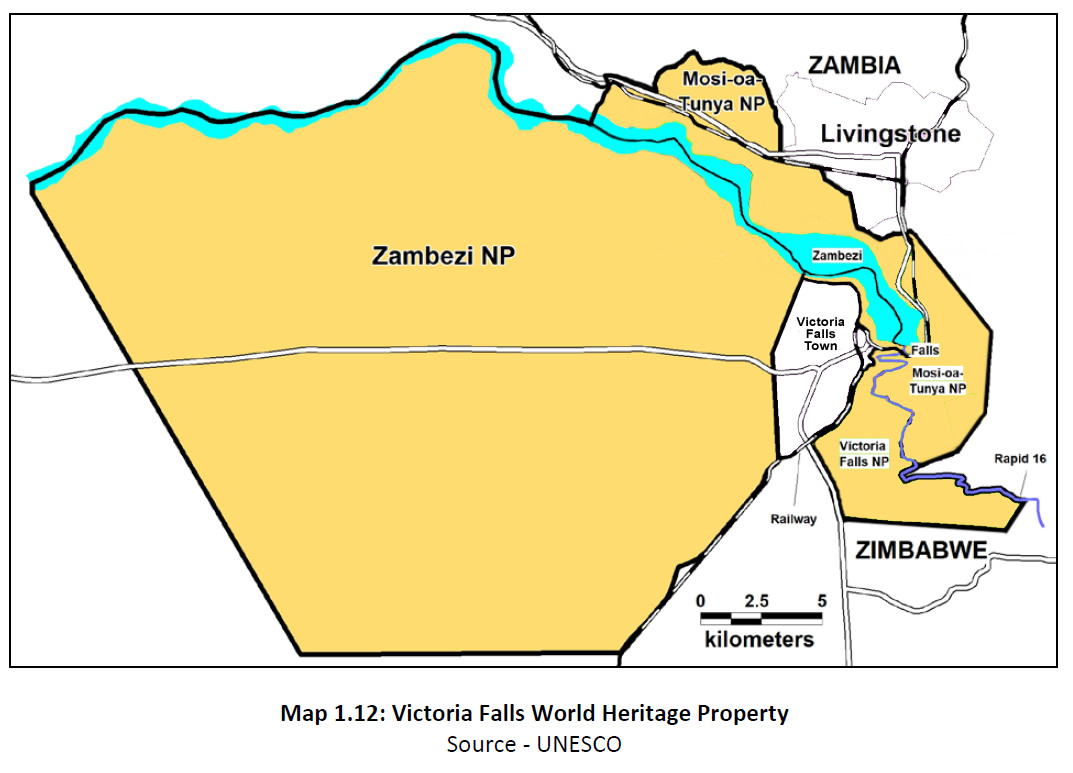
Map showing south bank Zambezi and Victoria Falls National Parks (Zimbabwe), together with north bank Mosi-oa-Tunya National Park (Zambia)
(Adapted from VFCC, April 2024)
[click image for larger view].
Next: Victoria Falls World Heritage Site
References
Links to external sites or pdf downloads, open in a new window.
Central Statistics Office (1989) 1982 Population: Main Demographic Features of the Population of Matabeland North Province, Central Statistics Office, Harare.
Central Statistics Office (1994) Zimbabwe Census Report 1992, Central Statistics Office, Harare.
Creewel, J. (2004) A History of the Victoria Falls Hotel - 100 years 1904-2004. [Edited and updated by Stan Higgins. Originally published in 1994 as ‘A history of the Victoria Falls Hotel - 90 Glorious Years 1904-1994.’]
IUCN (1996) Strategic Environmental Assessment of Developments Around Victoria Falls, Volume 1: Strategic Environmental Assessment Report. IUCN Regional Office for Southern Africa.
Moonga. K. (1999) The Development of Tourism in Livingstone District, 1945-1991. University of Zambia.
PlanAfric (2001) Victoria Falls Combination Master Plan, Victoria Falls Combination Master Plan Preparation Authority. Bulawayo.
Roberts, P. (2025) Footsteps Through Time - A History of Travel and Tourism to the Victoria Falls. Second Edition. Zambezi Book Company / CreateSpace Independent Publishing. (First published 2017, fourth edition July 2025).
Roberts, P. (2026) Paradise Lost? Conservation and Development of the Victoria Falls (1900-2025). First Edition, February 2026. Zambezi Book Company / CreateSpace Independent Publishing.
U.S. Department of State (1964) International Boundary Study, No.15, March 1964. The Geographer Office of the Geographer Bureau of Intelligence and Research