Keep Victoria Falls Wild
Existing Developments
Mosi-oa-Tunya National Park (Zambia)
Sun International and Royal Livingstone Hotels
Mosi-oa-Tunya InterContinental Hotel (1968)
InterContinental Redevelopment (1997)
Monitoring Mission (2000)
Zambezi Sun & Royal Livingstone (2001)
Avani Victoria Falls Resort (2015)
Mosi-oa-Tunya InterContinental Hotel (1968)
After decades of inviting investors to develop the site adjoining the Falls on the north bank, the Mosi-oa-Tunya InterContinental Hotel was finally opened in 1968. The hotel, located less than five minutes walk from the Falls, consisted of 95 rooms in two double-story blocks, set out at angles to the main building, housing the public areas and hotel administration. Developed by InterContinental Hotels & Resorts, part of Pan American Airways, the Hotel was operated in conjunction with the InterContinental Hotel in Lusaka. Many mourned the developments so close to the Falls, Teede and Teede later recording:
“Lights from the Mosi-oa-Tunya Hotel in Zambia interfere with moonlight viewing of the Main Falls from Zimbabwe and have ruined the spectacular series of lunar rainbows visible over the Rainbow Falls. Any more lights and the almost transcendental experience of seeing the Falls by moonlight would be totally lost.” (Teede and Teede, 1994)
Fortunately earlier plans for a ten-storey ‘millionaire’s playground’ with rooftop gardens overlooking the Falls were abandoned as unsuitable to the setting.
InterContinental Redevelopment (1997)
The site of the old InterContinental Hotel on the north bank immediately above the Falls - derelict and decaying after many years in the tourist doldrums - was offered for redevelopment in 1997. The lease of the site, including the neighbouring Rainbow Lodge and additional connecting National Parks land, was acquired by Sun International of South Africa. The agreement included a capital investment commitment of over $50 million for the redevelopment of the site and the building of a 250 room family hotel, 120 room luxury 5-star hotel and a 50 room bush lodge.
In 1998 the World Heritage Centre recorded the following comments in response to the preliminary Scoping Report:
“At the request of the Centre, IUCN has reviewed the ‘Scoping Report: Potential impacts associated with the proposed development of the Mosi-Oa-Tunya Hotel Complex,’ prepared by the Division of Water, Environment and Forestry Technology, CSIR, South Africa. This report was commissioned by Sun International, the company that would like to develop this hotel complex in the Zambian side of this trans-border World Heritage site. In brief, IUCN’s comments are:
a) The report is of a high technical quality and has fully recognised and considered the recommendations from the ‘Strategic Environmental Assessment of Developments Around Victoria Falls,’ prepared and published by IUCN, in 1996.
b) The main problem still remains to be the fact that this development is proposed within the boundaries of the World Heritage site.
c) However, as observed in the report, the area proposed for development has been already affected by existing hotel infrastructure and the new development will not cause any further degradation of the site but in fact may contribute to rehabilitating and improving the scenic qualities of the area.
“The report fully recognises a series of potential environmental and social impacts, most of them in line with previous reports prepared by IUCN on this site, but has not suggested clear ways and means to solve or mitigate them. Since the proposed development is extensive, Livingstone based authorities may not have the capacity to deal with issues such as security, health problems, sewage disposal, etc. The Central Government of Zambia must intervene to solve these problems. However, no information has been received from the Zambian Government on how it intends to respond to these issues.
“Stakeholders involved in this development proposal stressed the economic importance of this project for Zambia and have expressed the wish that the project is executed as soon as possible.
“From IUCN’s point of view, the key issues of concern are:
a) The location of the proposed development is within the boundaries of the site and particularly close to the banks of the rivers.
b) Institutional support that should be provided by the Zambian Government to address environmental problems is not defined;
c) Given that the site belongs to two State Parties, the Government of Zambia needs to discuss the project with the Government of Zimbabwe, to seek the latter’s agreement on implementation policies, procedures and schedules.
“The response of the Zimbabwean Department of National Parks and Wildlife Management (ZDNPWLM) to the hotel development proposal of Sun International has been transmitted to the Centre, on 25th September 1998, by the Zimbabwe National Commission for UNESCO. ZDNPWLM has emphasised the need to preserve the World Heritage site as a global asset and stressed that any development proposal should be subject to EIA procedures that invite full public involvement. ZDNPWLM has pointed out that it lacks details and information on the hotel development proposal. Hence, ZDNPWLM is unable to make specific and constructive comments or endorse the development proposal.” (UNESCO, 1998)
The recommendations concluded with a request for the State Parties to hold a bilateral meeting:
“The Bureau requests the Centre to co-operate with the IUCN Regional Office for Southern Africa to organize a bi-national meeting to bring the Governments of Zambia and Zimbabwe together. The meeting should be designed and organized in a manner so as to clarify issues concerning this development project in accordance with the joint responsibility of the two State Parties to conserve and properly manage this transborder World Heritage property.” (UNESCO, 1998)
The following year (1999) it was recorded that the meeting was 'being planned':
“The bi-national meeting is being planned to discuss the threat of inappropriate tourism development and improvement of co-ordination and consistency between site management of the two countries. A mission to review the situation at the Victoria Falls site recommended that the bilateral meeting be preceded by individual country meetings with the aim of establishing a basis for improved joint management of the site. Each country would prepare concise position statements to act as a basis for improved joint management of the site. IUCN has been requested by the two countries and the Centre to facilitate the bilateral meeting.”
An additional note, however, detailed further delays.
“IUCN’s Regional Office for Southern Africa was intending to organise a bilateral meeting for 28th July 1999 but it was not held because of lack of funding. IUCN recommends that a formal request be submitted by the State Parties to fund this meeting in 2000.” (UNESCO, 1999)
Monitoring Mission (2000)
In 2000 UNESCO carried out a site visit to the Falls in response to the Sun International redevelopment, reporting:
“The Bureau was informed that the Secretariat undertook a Mission to Victoria Falls on 1st June 2000 and held discussions concerning recommendations of the last session of the Committee with both the Zambian and the Zimbabwean authorities on both sides of the site. The Mission was informed that national and bilateral meetings would be held in August 2000. The Delegate of Zimbabwe, speaking on behalf of both State Parties, confirmed to the Bureau the organization of the meeting in August 2000 to finalize a number of issues concerning the management of the site.” (UNESCO, 2000)
A further note confirmed the meeting of a Zimbabwean stakeholders and formation of a Technical Committee
“The Centre received an undated letter from the Deputy Executive Director of the Zimbabwe National Museums and Monuments concerning the proposed bilateral meeting between Zambia and Zimbabwe on Victoria Falls/Mosi-oa-Tunya National Park. In the letter the Centre was informed that on 17th August 2000 the Zimbabwe National Commission for UNESCO convened high level meeting of the Zimbabwe National stakeholders and that this meeting recommended the setting up of a National Technical Team to produce a comprehensive conservation status report of the property prior to the joint Zimbabwe/Zambia meeting.
“The letter said that the report would enable the National Commission for UNESCO to facilitate a joint proposal to request financial assistance to enable the State Parties to organise a bilateral meeting, and that the request was scheduled to be submitted to the World Heritage Committee before 15th September 2000. The Centre was informed through the same letter that the Zimbabwe Technical Team will meet and submit its report on 14th September 2000 and thereafter Zimbabwe would meet with Zambia. So far no report has been received from Zimbabwe confirming as to whether the above meetings have taken place and no report has been received.” (UNESCO, 2000)
In 2001 the Committee noted that despite receiving UNESCO funding the meetings still had not been initiated (UNESCO approved funding of US$63,485 to the State Parties towards the hosting of meetings and workshops relating to the joint management of the Site in 2001). Meanwhile the Sun International redevelopment continued, opening in mid-2001 before the convening of the joint meetings which were supposed to discuss its development and mitigate its impacts on the WHS.
Zambezi Sun & Royal Livingstone Hotels (Zam, 2001)
Overlooking the Falls from the north bank, the redevelopment of the old InterContinental Hotel site established Livingstone as a serious competitor to Zimbabwe’s traditional dominance in the tourism market. The $69 million redevelopment of the 46 hectare site by Sun International included the construction of the Royal Livingstone Hotel (173 rooms), opened in July 2001 to opulent five-star standards, and neighbouring three-star sibling, the Zambezi Sun Hotel (212 rooms).
The project embraced the EIA process, attempting to minimise negative impacts and implementing mitigations where possible, including the exclusive use of native plant species within the grounds. Despite this the development has resulted in the modification of a significant section the riverine fringe immediately above the Falls, including use of a rock barrier and electric fence to prevent hippo accessing grounds from the river. The wider site was also fenced, disrupting local elephant movements, and stocked with a small number of captive giraffe and zebra.
The construction also involved the controversial disruption of stone and iron-age archaeological sites, including the excavation removal and ultimate reburial of stone and iron-age artefacts dating back 60,000 years.
Together with other riverside lodges the majority of Livingstone’s tourists were now accommodated outside of the town itself, in developments closer to the Falls, with the Zambezi Sun Hotel accounting for more than half of Livingstone’s tourist overnight visitors in 2005, attracting 60,000 additional tourists to Zambia, equivalent to 10% of the total number of national visitors over the year (Kaunda et al, 2013, quoted in Chomba and Sianjobo, 2014).
The resort was significantly refurbished in 2012.
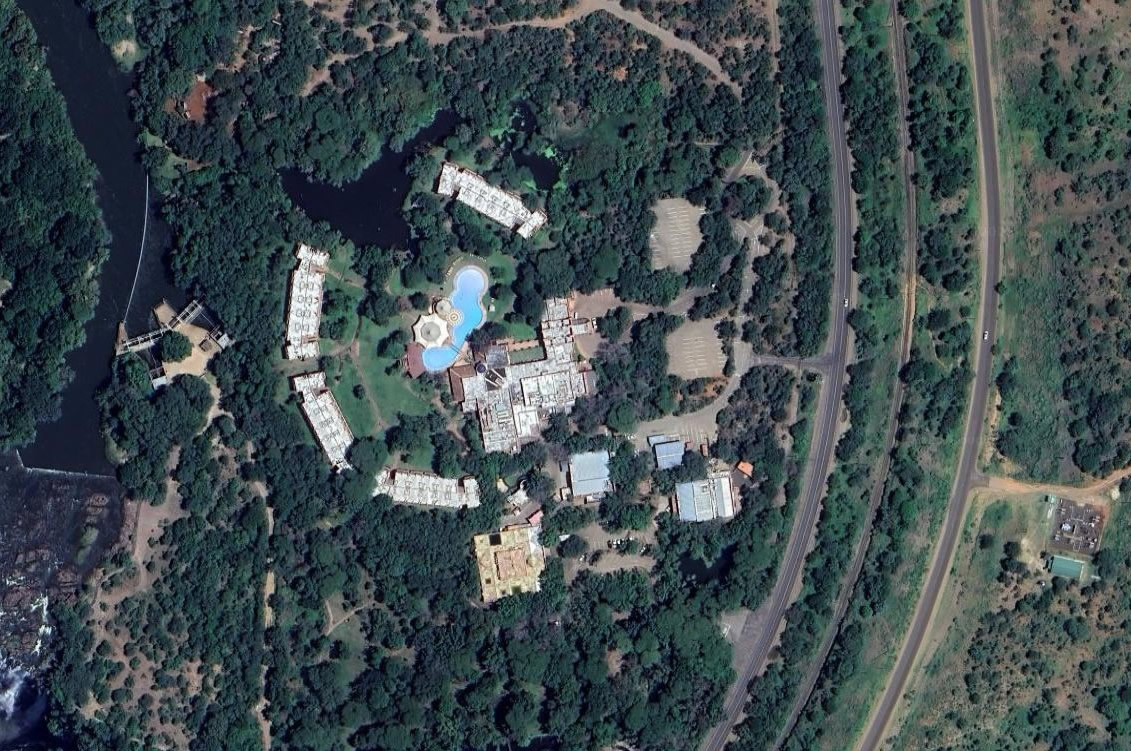
Area of Avani Victoria Falls Resort (2025)
[click for larger view]
Avani Victoria Falls Resort (2015)
In December 2014 Minor Hotel Group (MHG) announced the rebranding of the Zambezi Sun International Hotel on the north bank of the Falls as the Avani Victoria Falls Resort.
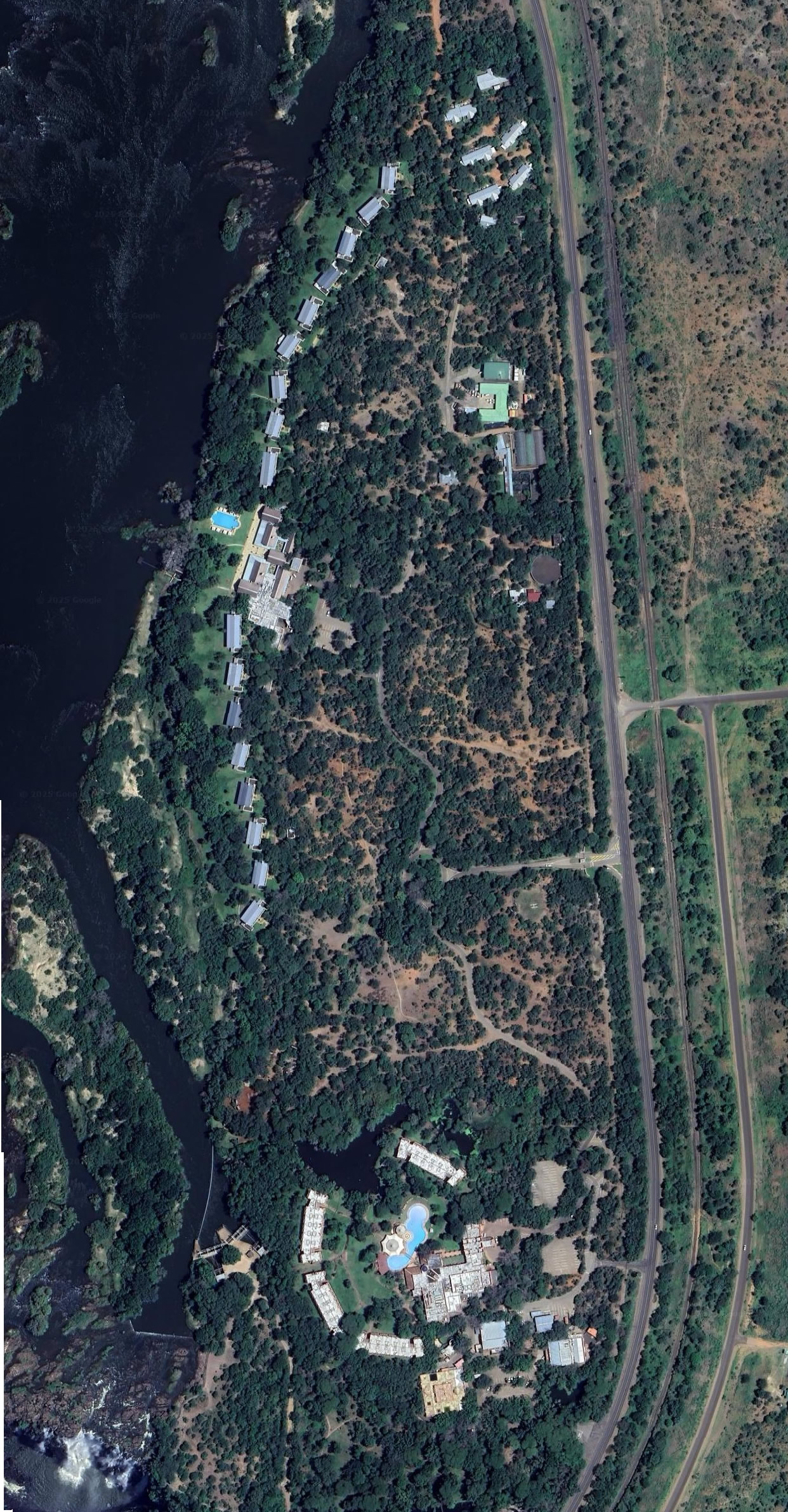
Area of Avani Victoria Falls Resort and Royal Livingstone by Anantara (2025)
[click for larger view]
References
Roberts, P. (2025) Footsteps Through Time - A History of Travel and Tourism to the Victoria Falls. Second Edition. Zambezi Book Company / CreateSpace Independent Publishing. (First published 2017, fourth edition July 2025).
Victoria Falls Bits and Blogs (20th December 2016) Minor Hotel Group Acquires Avani Livingstone Hotels.