Keep Victoria Falls Wild
Conservation and Development of the Victoria Falls
Increasing Pressures
Wild Horizons Estate
Rainforest Rumbles
Bungee Expansion
Last Refuge
Increasing Pressures
Victoria Falls River Lodge
Increasing Highs
Gorge Lookout
Ilala Lodge Spreads its Wings
Commercial Asset
The following text has been adapted (with permission) from
researched and written by Peter Roberts and published in February 2026
Increasing Pressures
Visitor arrivals to Zimbabwe recovered to reach successive record highs of 2,286,572 in 2006 and 2,505,988 in 2007, including 1,787,663 tourist visitors (self-identified as on holiday or visiting friends or relatives) in 2006 and a record number of 2,104,291 tourist visitors in 2007. Arrivals from African countries (including for non-tourism purposes) rose to highs of 2,290,608 in 2007, while overseas arrivals achieved modest increases from 203,555 to 215,380 in 2007. Visitors from European countries dropped to a low point of 96,849 in 2006 and North American arrivals followed with a low of 39,747 in 2007 (Zimbabwe Tourism Authority, 2008).
Zimbabwe received 1,956,594 visitor arrivals in 2008, including 1,809,828 tourist arrivals, rising to 2,017,262 in 2009, with 1,864,124 tourist arrivals. Overseas visitors increased from 224,272 to 337,180 in 2009. Arrivals from Asia reached new highs of 76,945 visitors in 2009, up from 46,849 the previous year, with recorded arrivals from European countries recovering from 108,159 in 2008 to 155,864 in 2009 and North American arrivals increasing from 43,412 to 57,864.
The nine main tourism hotels on the south bank, offering 971 rooms and 1,772 beds, recorded low average room occupancies of 28 percent in 2008 rising to 40 percent in 2009 (Anchor Environmental Consultants, 2019). Additional capacity, provided by 61 safari camps, lodges, guest houses and backpackers, and providing an additional 549 rooms and 1,177 beds, recorded room occupancies of 20 percent in 2008 and 24 percent in 2009 (Zimbabwe Tourism Authority, 2009, 2011). The Falls Rainforest reported 244,182 visitors over 2008, dropping to 116,223 in 2009, despite the increase in tourism and overseas arrivals.
Wild Horizons Estate
In 2007 local operator Wild Horizons launched the Wild Horizons Estate, a fenced privately managed wilderness concession covering a significant area of the Victoria Falls National Park. The Wild Horizons Wildlife Trust was formed in 2008 (renamed the Victoria Falls Wildlife Trust in 2012) to support local wildlife conservation management initiatives, including a flagship project establishing a specialist modern veterinary laboratory and wildlife rehabilitation facility.
In 2010 Wild Horizons launched a new $1 million luxury safari camp, The Elephant Camp, located within the Wild Horizons Estate. The initial development consisted of 12 luxurious, tailor-made tented lodge units. A new extension, the Elephant Camp West, opened in April 2015, consisting of four tented suites overlooking the gorges below the Falls.
The Estate covers a significant section of the Victoria Falls National Park and World Heritage Site - although there appears to have been no direct prior disclosure to UNESCO in relation to the allocation of this concession, or any of the subsequent infrastructure developments within its area. There is no direct reference to the Estate in any of the recent State of Conservation Reports or Joint Management Plans.
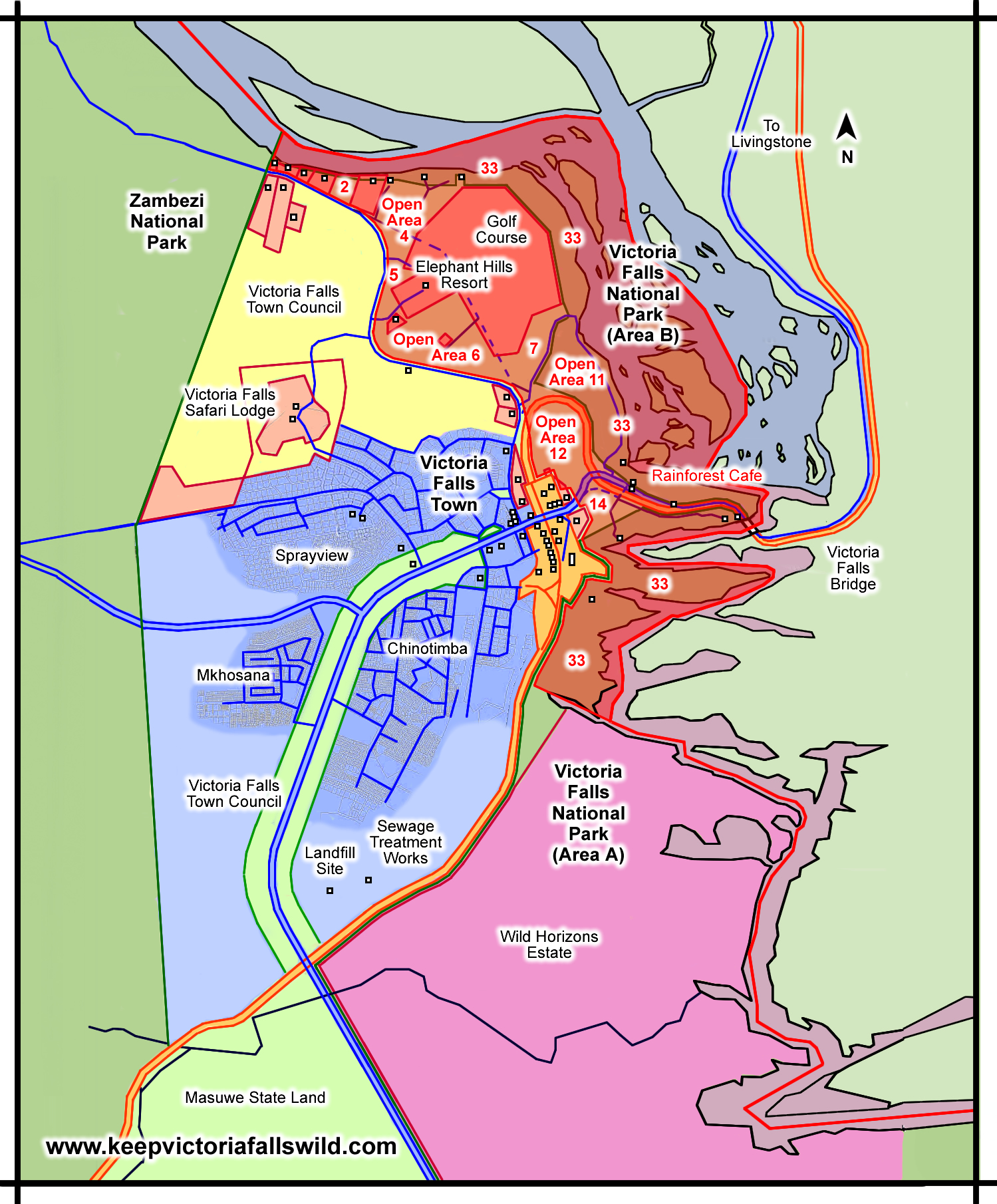
Developments within the Council-controlled area, 2001-2010, showing Open Land Areas (shaded in red, numbered) designated as permanently protected under the 1975 Outline Plan. New developments within this area since the 2001 Plan in red.
(Adapted from Plan Afric, 2001)
[click image for larger view].
Rainforest Rumbles (2010)
The Zimbabwe Parks and Wildlife Management Authority partnered with local activity provider Shearwater Adventures, trading through the Zambezi Helicopter Company, in a much needed, yet controversial, redevelopment of the Falls Park visitor reception facilities in 2010 - the 2006 UNESCO Monitoring Mission Report described the rainforest visitor centre as "very basic and consists of disfigured and vandalized exhibits" (World Heritage Committee, 2007a).
The development included the conversion of the information centre into a modern commercial store selling high-value tourism souvenirs and the construction the Rainforest Cafe and supporting facilities. An outdoor interpretation and information area was developed, with detailed displays on the natural history and formation of the Falls, as well as upgrading of toilets and other visitor facilities.
The project divided opinion and attracted a substantial amount negative publicity and media coverage. Stakeholders in the town’s tourism sector argued that there had been no formal Environmental Impact Assessment process, with no public notification or consultation ahead of the development.
Even government departments clashed, the development reigniting a long-running dispute over the management of the Rainforest. The National Museums and Monuments of Zimbabwe (successor to the Commission for the Preservation of Natural and Historical Monuments and Relics) had raised the issue of the management of the Victoria Falls Special Area in 1999, with a subsequent legal arbitration by the Attorney General in 2000 confirming the NMMZ's right to administer the site
"As the matter unfolded, no political decision was made to allow the NMMZ to take over the administration of the Special Area from the ZPWMA. The matter was taken to the President’s Office where a mediator was appointed. The mediation process was carried out and it was recommended that the NMMZ and the ZPWMA should co-own and administer the Special Area together for an agreed period until the NMMZ completely took over its administration. The mediation recommendations have never been implemented and the ZPWMA has continued to own and manage the Special Area while the NMMZ has continued to pursue strategies to ensure that its mandate of administering the monument is implemented." (Makuvaza, 2012)
Forced to act by the new restaurant development, NMMZ argued that its construction was not in line with laws governing the management of National Monuments and that the building negatively impacted on the integrity of the site. With the support of Zimbabwe Republic Police, NMMZ exercised legal powers to take control of the Victoria Falls visitor facilities, reclaiming their historic management of the Victoria Falls Special Area and closing the restaurant.
After a short period of impasse, and an eventual government ruling, the Rainforest returned to the control of the Parks and Wildlife Management Authority and the restaurant facilities reopened. Negotiations between NMMZ and ZPWMA over the joint management of the site are still ongoing, with both institutions legally authorised to manage the site through different Statutory Instruments.
Additional plans for a proposed $6 million development of the ‘V.I.P. Entrance’ beside the Devil’s Cataract, including restaurant, shopping and conference facilities overlooking the edge of the Falls, appear to have been quietly suspended (Victoria Falls Bits and Blogs, November 2010).
Bungee Expansion (2010)
In 2010 an expanded bungee reception facility, including a restaurant and bar with viewing deck overlooking the Bridge, was opened on the northern bank. The visitor centre includes a small interpretive museum displaying information on the history of the Bridge, free to visitors, and the starting point for guided historical tours, including the opportunity to explore the gangways under the Bridge.
The development, operated by the Zambezi Adrenaline Company (part of the Shearwater Adventures portfolio of companies), also expanded to include a 80m Bridge swing and 300m zip line with associated pathways, viewpoints and infrastructure on the north bank immediately below the bridge.
The site lies within the Mosi-oa-Tunya National Park and core area of the World Heritage Site, although there again appears to have been no direct prior disclosure to UNESCO in relation to the infrastructure developments. There is no direct reference to the development in any of the recent State of Conservation Reports or Joint Management Plans.
Last Refuge (2011)
During 2011 local tourism operator Wild Horizons investigated operating tours to Cataract Island from the south bank, having received permission to use the island for tourism purposes. The isolated island is the last pristine refuge for the fragile flora sustained by the spray of the Falls - highly impacted by visitor numbers across the rest of the site. After widespread negative reaction Wild Horizons withdrew their plans on the understanding that the island would continue to be protected in its pristine natural state (Victoria Falls Bits and Blogs, December 2016).
The Island is located in the core area of the Victoria Falls National Park and World Heritage Site, yet there appears to have been no direct disclosure to UNESCO in relation to the proposal.
Increasing Pressures
The Zimbabwe Tourism Authority (Z.T.A.) reported a healthy increase in visitor arrivals in 2010, with figures for the year reaching 2,239,165, including 1,827,163 tourist arrivals. Overseas visitor arrivals reached 287,194 over the year. The increase was largely credited to the positive effects of national political and economic stability and the regional benefits of the F.I.F.A. Football World Cup tournament hosted in South Africa. Average annual hotel occupancy on the south bank rose to 46 percent for the main tourism hotels and 28 percent among the smaller camps, lodges, guest houses and backpackers in the resort town.
Visitors to the Falls Rainforest reached 141,113 during 2010 (Zimbabwe Tourism Authority, 2011). The totals appears to have been subsequently revised to 160,517 visitors, including 110,300 international tourists (Anchor Environmental Consultants, 2019). Zambia recorded a total of 138,148 visitors to the Falls over the year, including 51,411 international visitors. The revised figures reported indicate a combined total of 298,655 visitors to the Falls over the year, in contrast to a figure of 232,40 reported to U.N.E.S.C.O. (World Heritage Committee, 2012).
In their 2010 report to U.N.E.S.C.O a combined daily carrying capcity for the Falls was estimated at 6,000 visitors per day (see also 'Loved to Death').
"The States Parties report touches very briefly on the estimated carrying capacity of the property (up to 6,000 visitors per day), and consider that the property is not exceeding this capacity on an annual basis. Twenty boats and nine helicopters are said to be operating in the property since 2007. " (World Heritage Committee, 2010)
In 2011 Zimbabwe relaunched its international tourism marketing brand under the banner ‘A World of Wonders,’ recording new record levels of 2,423,280 visitor arrivals over the year, including 1,892,868 tourist arrivals and 381,261 overseas visitors. Arrivals from Asian countries reached new highs of 88,782 visitors, while North American countries grew to 89,756 and European arrivals to 154,303 (Zimbabwe Tourism Authority, 2012). Hotel operators in the Falls recorded rising occupancy levels for the year with growth credited to new markets such as Eastern Europe, the Middle East and Asia. Average room occupancy on the south bank rose to 50 percent for the main hotels and 28 percent for smaller accommodation providers.
A total of 200,125 visitors to the south bank Rainforest were initially reported during 2011 (Zimbabwe Tourism Authority, 2012). The figure appears to have been subsequently revised down to 120,251 visitors, including 72,151 international tourists (Anchor Environmental Consultants, 2019). Zambia recorded a total of 133,053 visitors for the year, of which 40,206 were international visitors. A combined total of 215,380 visitors to the Falls were reported to U.N.E.S.C.O. but with the figure only representing the first 11 months of the year (World Heritage Committee, 2010). The subsequently revised figures suggest a combined total of 253,304 visitors over the year.
Zimbabwe visitor arrivals declined significantly from the highs of the previous year to 1,794,230 in 2012, with tourism arrivals dropping to 1,244,441 and overseas visitors decreasing to 231,608. Visitors from European countries declined to 111,529, North America 58,873 and Asia 36,499. Average room occupancy for the main tourism hotels on the south bank of the Falls decreased slightly to 45 percent, while smaller providers recorded 50 percent room occupancy levels over the year.
Despite the declines in tourism arrivals 197,776 visitors to the south bank Rainforest were recorded over 2012, including 136,980 international tourists (Zimbabwe Tourism Authority, 2013). Zambia recorded a total of 151,005 visitors to the Falls, including 42,090 international visitors (Zambia Ministry of Tourism and Arts, 2016). The figures recorded suggest a combined total of 348,781 visitors to the Falls over the year, in contrast to a figure of 195,00 reported to U.N.E.S.C.O (State Parties, 2014). In December alone 22,521 tourists visited the south bank Rainforest, including 11,108 international visitors.
Victoria Falls River Lodge (2012)
A new riverside development located within the Zambezi National Park, the 26-bed Victoria Falls River Lodge, opened in April 2012. Developed by Zambezi Crescent, the lodge is sited within the small section of the upstream Park included within the World Heritage Site but notably excluded from maps presented to UNESCO. The development initially included 13 luxury tented suites spaced out along extensive section of riverfront. In August 2017 the lodge expanded with the opening of six ‘tree house suites’ located on Kandahar Island.
Pioneers Camp (2013)
The upstream riverside Pioneers Camp, located about 20 km upstream of the Falls within the Zambezi National Park, opened in mid 2013, offering six tented units.
"Welcome to Pioneers Camp which is finally ready for 12 guests with 6 large en-suite safari tents. Three are nestled in the bush on the ‘the wild side’ although only metres from the river bank, and three are on the banks of the Zambezi River. All have private decks with panoramic views of the river and enjoy spectacular sun-rises." (Zambezi Traveller, May 2013)
Site previously known as Impala Jena (‘white impala’), one of three riverside overnight ‘fishing’ camps within the Park previously available for visitors and operators to book as part of their safari tour.
The development was relaunched under new management as Mpala Jena Camp in February 2019.
Increasing Highs
Zimbabwe recorded visitor arrivals of 1,832,583 over 2013, although tourism arrivals decreased for the second year in succession to 934,757. Overseas visitors recovered slightly to 261,784. The main tourism hotels in the Falls (representing nine hotels and 971 rooms) recorded healthy room occupancy levels of 53 percent and the smaller providers (representing 549 rooms) 42 percent over the year. The top eight hotels recorded combined revenues of over $23 million and 178,000 visitor room-nights, up from $19 million and 159,000 rooms the previous year.
Zimbabwe recorded a total of 196,041 visitors to the Falls, including 144,680 international tourists (Zimbabwe Tourism Authority, 2014). Zambia recorded 152,952 visitors to the north bank, including 51,969 international visitors. The figures indicating a combined total of 348,993 against the total of 252,800 reported to U.N.E.S.C.O (State Parties, 2014).

2011-13 Victoria Falls monthly visitor numbers
The town’s total population was estimated at 33,718 in 2012 (Central Statistics Office, 2012), with the supporting suburban areas of Chinotimba and Mkhosana - developed on the site of the old Sprayview Aerodrome - expanding rapidly in recent years.
Zimbabwe recorded a small but steady increase in visitor arrivals during 2014, with year end totals of 1,880,028, despite the equatorial ebola epidemic casting a shadow over travel to the continent. Tourism arrivals dropped further to a low of 906,198 while overseas visitors increased slightly to 279,53 over the year.
Peak-season tourism arrivals at the Falls returned to the levels of the late 1990s, with the main hotels at Victoria Falls reporting occupancy rates of 77 percent in August 2014, up from 62 percent in the same month in 2013. Annual average room occupancy, however, fell slightly to 49 percent in 2014, with August and September the busiest months, recording occupancy levels of 80 and 66 percent, and January and February as the lowest, with 33 and 32 percent occupancy (Zimbabwe Tourism Authority, 2015).
The south bank recorded a total of 241,351 visitors to the Rainforest in 2014, including 173,841 international visitors (Zimbabwe Tourism Authority, 2015). Zambia recorded 153,790 visitors to the north bank, including 45,303 internationals, and agreeing the combined total of 353,025 visitors presented to U.N.E.S.C,O. in 2014 (State Parties, 2016).
Increasing tourism development pressures continued to cause concern. Local resident Trevor Lane, speaking in 2015, warned of the dangers of over-developing the Falls.
"I think what we got to be careful of is that we don't sort of over capitalize... We don't want to make it into another Niagara Falls where it's over commercialized." (Victoria Falls Bits and Blogs, January 2015)
Gorge Lookout
In December 2014 Wild Horizons opened the new Lookout Cafe, part of a redevelopment of their gorge activity centre, perched overlooking the second and third gorges below the Falls. The development included a rebuild and expansion of the existing thatched structure, landscaped terraced gardens and the clearance of a large area of natural bush for customer car parking. The gorge activity centre was originally developed in 2001 with the construction of a small thatched building and installation of high-wire infrastructure across the gorges, offering a bungee swing, zip-line and abseiling activities. The centre expanded its activities with the introduction of zip-line ‘canopy tour’ in the bend of the second and third gorges in mid-2013.
The Lookout Café was burnt down to the ground after a suspected electrical fire early on Christmas Eve 2018. The traditional wooden thatch building was completely destroyed (Victoria Falls Bits and Blogs, December 2018). Plans for a significant redevelopment were quickly announced and a significantly expanded new Lookout Café reopened in January 2020.
The development lies within the core area of the World Heritage Site - yet there appears to have been no direct prior disclosure to UNESCO in relation this development, or any of the subsequent infrastructure expansions. There is no direct reference to the development in any of the recent State of Conservation Reports or Joint Management Plans.
Ilala Lodge Spreads its Wings
Ilala Lodge began a significant extension in November 2014 with the development of a new three-storey wing (raising the profile of the previously two-storey building), adding an additional 20 deluxe rooms and two executive suites, and expanding the hotel to a total of 56 rooms. The new wing opened in October 2015.
Commercial Asset
Pressure to develop new commercial tourism projects and products continued to drive the development of the local Falls environment, in many cases resulting in proposals inappropriate and unsuitable to its protected National Park status and UNESCO. World Heritage listing. Proposals rejected under UNESCO guidelines during the period included bids to operate tethered observation balloons and an amphibious vehicle from the north bank. The south side has also seen attempts to launch tours to Cataract Island, the last remaining fragment of the Rainforest untouched by modern tourism pressures (Victoria Falls Bits and Blogs, December 2016).
In late 2014 Zimbabwe Tourism Authority Chief Executive Officer, Karikoga Kaseke controversially proposed that Zimbabwe and Zambia should even forego the UNESCO listing of the Falls and instead maximise commercial revenues.
"We don’t need the Falls to remain a natural world heritage site as stipulated by United Nations Educational, Scientific, and Cultural Organisation (UNESCO). We need to go the Niagara Falls way and make money for our people and our economies. We can gain a lot of benefits if we commercialise it... We need to electrify Victoria Falls and start running it on 24 hours basis instead of closing the premises in the night" (Victoria Falls Bits and Blogs, November 2014).
Mr Kaseke said Niagara Falls attracted $30 billion annually, compared to less than $500,000 at the Victoria Falls for Zimbabwe and Zambia. Mr Kaseke expanded that Victoria Falls had potential to raise more revenue from tourists if the Falls Rainforest had electric lighting to enable night-time visits, steady water flows, restaurants, accommodation facilities and other modern amenities like at Niagara.
Chief Mukuni countered that tourists around the world travelled to the Falls to see them in their natural form, undeveloped and untouched by commercial development.
"In my opinion, we should keep the Falls as natural as possible and not commercialise it." (Victoria Falls Bits and Blogs, November 2014)
In June 2016 the Zimbabwe Tourism and Hospitality Industry Minister, Walter Mzembi, was reported in the national press describing Victoria Falls as a potential $4.8 billion ‘cash-cow,’ quoting an average per tourist spend of $1,200 and predicting an incredible 4 million annual visitors to both sides of the river (Victoria Falls Bits and Blogs, June 2016).
Next: The 2016 Joint Plan
References
Links to external sites or pdf downloads, open in a new window.
Anchor Environmental Consultants (2019) Batoka Gorge Hydro-Electric Scheme Environmental and Social Impact Assessment. Economic Assessment.
Makuvaza, S. (2012) Who Owns the Special Area at Victoria Falls World Heritage Site? The Historic Environment, Vol.3 No.1, April, p42-63. [pdf]
Roberts, P. (2025) Footsteps Through Time - A History of Travel and Tourism to the Victoria Falls. Second Edition. Zambezi Book Company / CreateSpace Independent Publishing. (First published 2017, fourth edition July 2025).
Roberts, P. (2026) Paradise Lost? Conservation and Development of the Victoria Falls (1900-2025). First Edition, February 2026. Zambezi Book Company / CreateSpace Independent Publishing.
State Parties (2014) Victoria Falls State of Conservation Report, 2013.
State Parties (2016) 2016 Victoria Falls/Mosi-oa-Tunya State of Conservation Report and 2016-2021 Victoria Falls/Mosi-oa-Tunya Joint Integrated Management Plan (external download, opens in a new window).
Victoria Falls Bits and Blogs (June 2009) Vic Falls Heritage Status Threatened.
Victoria Falls Bits and Blogs (November 2010) Urban sprawl threatens Vic Falls.
Victoria Falls Bits and Blogs (November 2014) Chief Mukuni opposes the commercialisation of Victoria Falls.
Victoria Falls Bits and Blogs (January 2015) Majestic Victoria Falls: 'Zimbabwe's goldmine' draws back thrill-seekers [CNN]
Victoria Falls Bits and Blogs (June 2016) Vic Falls a $4,8bn cash cow: Minister.
Victoria Falls Bits and Blogs (December 2016) Cataract Island threatened by tourism development.
Victoria Falls Bits and Blogs (December 2018) Fire razes Victoria Falls’ Lookout cafe.
World Heritage Committee (2007a) Mission Report Mosi-oa- Tunya, Victoria Falls (Zambia/ Zimbabwe) 20-25 November 2006 (external download, opens in a new window)
World Heritage Committee (2007b) Decision 31 COM 7B.4.
World Heritage Committee (2008) Conservation issues presented to the World Heritage Committee in 2008.
World Heritage Committee (2010) Conservation issues presented to the World Heritage Committee in 2010.
World Heritage Committee (2012) Conservation issues presented to the World Heritage Committee in 2012.
Zambia Ministry of Tourism (2016) Tourism Statistical Digest 2015.
Zimbabwe Tourism Authority (2008) Tourism Trends and Statistics 2007.
Zimbabwe Tourism Authority (2009) Tourism Trends and Statistics 2008.
Zimbabwe Tourism Authority (2011) Tourism Trends and Statistics 2010.