Keep Victoria Falls Wild
Conservation and Development of the Victoria Falls
The 1996 IUCN Plan
The Unadopted Plan (1996)
Growing Pressures
Riverine Fringe
No Permanent Development
Buffer Zone
Riverside Proposals
Loved to Death
Increasing Impacts
South Bank Developments (late 1990s)
North Bank Developments (late 1990s)
The following text has been adapted (with permission) from
researched and written by Peter Roberts and published in February 2026
The 1996 IUCN Plan
The Unadopted Plan (1996)
During 1995 a Strategic Environmental Assessment (SEA) of development at the Victoria Falls was carried out for IUCN-ROSA on behalf of the Governments of Zambia and Zimbabwe with the aim of developing a joint management plan for the World Heritage Site. As part of the stakeholder consultation a Sustainable Development Workshop was held from 25th to 29th March 1996 in Livingstone (UNESCO, 1996). The assessment reviewed an area extending 30 km in radius from the Falls and considered various growth predictions over a ten year period.
The report included a detailed draft Skeleton Management Plan for the Site (IUCN, 1996c), sadly not officially adopted by the State Parties, although remaining an important reference document.
The report identified several key aspects to the Falls which combine to create a unique visitor experience:
"The Falls have created a number of important features which, together, make a visit to the Falls an unforgettable experience. These features are:
- the spray cloud:
- “mist” vegetation created by the spray and resultant humidity:
- the rain forest:
- the series of gorges:
- the upstream riverine areas including riparian forest. islands and open water.” (IUCN, 1996)
Growing Pressures
The detailed study reports, dated February 1996, noted that Victoria Falls town had been the fastest growing town in Zimbabwe and that the urban infrastructure, housing and land designations no longer matched the needs of the population or the tourism industry.
“Victoria Falls Town has been the fastest growing urban area in Zimbabwe. Between the 1992 census and the 1995 estimates, the population has grown at a rate of 14% per annum, and is now about 25,000 people... The urban infrastructure in Victoria Falls Town does not match the growth in urban population. The infrastructure was designed for a town of 8,000 rather than the current 25,000. There are major problems with water supply and drainage, and the sewage treatment works built in 1992, while technically having sufficient capacity, are reported to be discharging poor quality effluent. The solid waste dump is sited on a slope overlooking the sewage works and plainly visible at the entrance to the town, is unsuitable and a health hazard. The resources for waste collection are severely strained, as is the fire service.” (IUCN, 1996a, p.4)
The document highlighted the increasing number of buildings within the town exceeding two storeys and breaking the tree line, apparently breeching local planning guidelines.
“Some of the existing commercial buildings extend for 3 storeys, well above the tree line and the Council have expressed a wish that new commercial development should not be above 10 metres in height and should be subject to tree height within the area.” (IUCN, 1996b, p.60)
The plan identified a shortage of land for development within the Council-controlled area and future growth of the town.
"The 1973 Scheme for Victoria Falls Town has areas designated for hotel and tourism development, industrial development, commercial development residential areas and community facilities. Proposed expansion areas include Sprayview airfield, and the State land to the South West of the town. Future expansion of the town is constrained by the National Park boundaries and the minefields." (IUCN, 1996)
Among the key recommendations was the preparation of a statutory Master Plan for Victoria Falls and its surrounding area as a matter of urgency.
“The need to tackle the serious urban problems in both Livingstone and Victoria Falls Town has been recognised. A Master Plan for Livingstone is in the process of preparation, but the land designations in the Development Scheme for Victoria Falls prepared in 1973 are now fully allocated and a new legally binding Master Plan is required urgently.” (IUCN, 1996a, p.6)
The Reports appear to overlook the significance of the 1975 Outline Plan and there is no reference to the designation of ‘Open Land’ towards the Falls and River as being ‘permanently protected.’
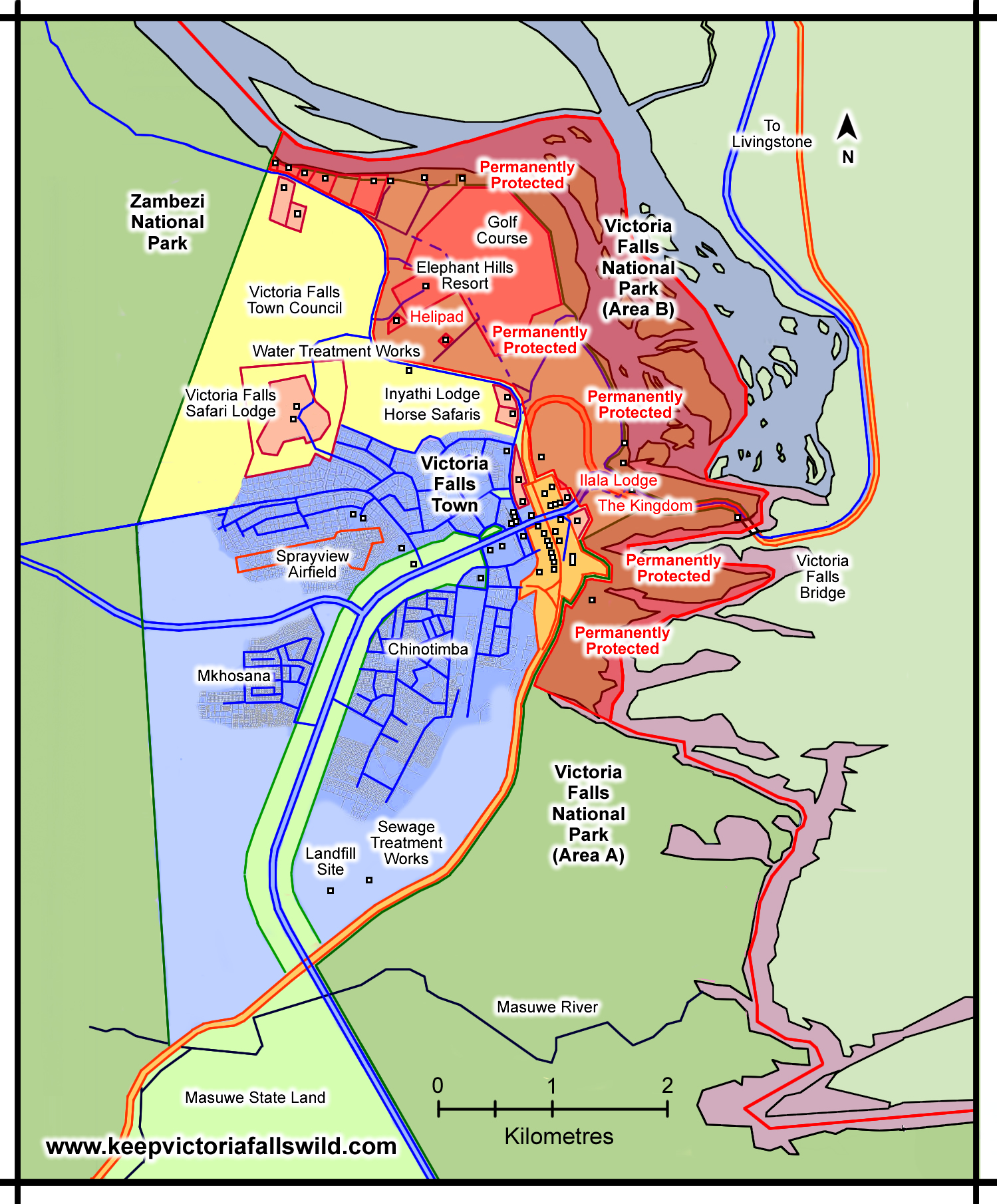
Developments at the Victoria Falls during the 1990s, showing Open Land Area
(shaded in red) designated as permanently protected under the 1975 Outline Plan.
New developments within this area since the 1975 Plan in red.
[click image for larger view].
Riverine Fringe
The Report highlighted the vulnerability of the wooded riverine fringes, remnants of once wider forests which were historically supported across the region by a wetter climate and which now survive only in these riverine habitats. In the current drier climatic conditions now prevailing over the region the woodland does not naturally regenerate when disturbed, giving way instead to mixed bush and scrub.
“When grossly disturbed, riverine forest cannot regenerate easily and gives way to xeric scrub. The Rain Forest and other parts of the riparian forest are vulnerable to disturbance by trampling which allows intrusion of ruderal species such as Lantana camara, Similarly where the spray from the Falls over the Eastern Cataract has been reduced during low flows, the growth of moisture dependent plants in inhibited and Lantana invades; this is particularly prevalent in the Zambian rain forest.” (IUCN, 1996b, p.30)
As a result the riverine fringe is considered highly ecologically sensitive to tourism development, recommending no further development in these areas, particularly the section of the south bank above the Falls:
“The upstream riverbank is considered the most sensitive area. The remaining small section within the Victoria Falls Town boundary should be protected against further development.” (IUCN, 1996a, p.14)
A later statement was more emphatic, but less specific (although again clearly aimed at the south-bank Council controlled riverside stands):
“No further development should be allowed in the World Heritage Site, nor along the river bank outside the National Parks areas.” (IUCN, 1996c, p.31)
No Permanent Development
The Report indicated the wider National Park areas on both sides of the river prohibit any permanent development.
“The three National Parks cover a wider area than the World Heritage Site and the legal protection in these areas is the same. This prohibits any permanent development but allows access with minimum management interventions. No hunting or tree cutting or removal of dead wood is allowed.” (IUCN, 1996b, p.21)
The Report also highlighted regulations regarding permitted temporary developments with the National Park areas.
"Temporary camp sites and picnic sites are permitted within these areas and these should follow the rules as laid out as for the Zambezi National Park, namely that all structures should be removed during the rainy season, that all structures, with the exception of septic tanks and soakaways which are permitted, should be removable within 24 hours. No mature trees or riparian vegetation should be cut down or removed without permission. Fuelwood should be brought in from outside and all wastes should be removed from the site on a regular basis. Jetties should be considered as temporary developments with the same conditions as above.” (IUCN, 1996c, p.36)
In a reference apparently directed at the north bank Mosi-oa-Tunya InterContinental Hotel the Report later emphasised that existing developments within these areas should not be allowed to expand further.
“The protected zones include the areas currently bounded by the National Parks and the World Heritage Site. These are the areas in which no permanent development should be allowed. Existing enclosures and buildings should be limited to their present extent and only sensitive rehabilitation should be allowed. Facilities for National Park and visitor management may be allowed subject to appropriate consultation and planning processes." (IUCN, 1996)
Buffer Zone
The Report also identified the need for a 500m Buffer Zone surrounding the protected area also preventing all new permanent development, although to be implemented with some flexibility in regard to existing developments.
“Around the protected areas [/WHS] there should be a Buffer Zone in which no permanent developments are constructed. This Buffer Zone is set for a distance of 500 m around unfenced protected area boundaries, and 200 metres from fenced protected area boundaries. In areas where there is constraint upon land e.g. in certain areas close to the World Heritage Site, this may be reduced to 100 metres but only with special permission.” (IUCN, 1996c, p.36)
Riverside Development
Despite the above statements, the document also detailed the proposed development by the Rainbow Group of a 182 room 5 star hotel and conference centre between the A’Zambezi Hotel and derelict Zambezi Camp and Caravan Site.
“The siting of the proposed Rainbow Group hotel conference centre is considered to be too large and inappropriate for a river front development, adjacent to the World Heritage Site, especially as proposed with a three-storey building which would protrude above the existing tree height and which would curtail animal movement along the river bank.” (IUCN, 1996c, p.31)
The planned development was not realised and the plot remains vacant (although with new hotel development proposals announced in 2001 and in 2023- see the Victoria Falls Resort proposal).
Loved to Death
The increasing numbers of visitors to the Falls, however, raised concerns over the long-term integrity of the site. In 1990 Heath estimated an annual maximum carrying capacity figure of 100,000-125,000 visitors for the Rainforest, noting that ‘further pressure on the Victoria Falls area could be environmentally detrimental.’
“The number of visitors [at] the Victoria Falls has already approached the figure which the Department of National Parks and Wildlife Management estimates as being the maximum which the Falls area can accommodate. A further increase could see the Victoria Falls in danger of being ‘loved to death.’” (Heath, 1990)
Heath’s higher estimate equates to an average of 342 visitors a day (just over 10,000 a month), although this does not account for the marked seasonality of tourism to the Falls. The 1996 IUCN SEA report also raised concerns over the impacts of high visitor numbers, calculating the carrying capacity on both sides of the Falls to be 250 people at any one time and a daily limit of 3,000 visitors.
“The rainforest walk is the primary attraction which brings tourists from all over the world. The carrying capacity of the Rainforest walks limits the carrying capacity of the whole area. The rainforest is showing indications of stress in terms of trampled vegetation and soil erosion, the litter, especially on the Zambian side, the threat of fires during the dry season, and the visual impacts of increasing numbers of visitors...
“The carrying capacity of the rainforest is based upon the number of people in the rainforest at any one time. Calculations by the study team showed that on both the Zambian and Zimbabwean side, the carrying capacity was about 250 persons at any one time giving 1,250 persons on an average day and up to 3,000 persons per day on a capacity day.” (IUCN, 1996a, p.9-10)
Increasing Impacts
The early 1990s saw a rapid increase in tourism to the south bank, the report highlighting a fourfold increase in visitors and resulting in increasing development pressures. Accommodation providers on the south bank of the Falls offered an estimated 1,144 rooms (predicted to expand to 1,536 rooms) against only 367 rooms on the north bank.
“There are now 10 major hotel and lodge sites within the Victoria Falls Town area with 1,019 rooms... Two more are under construction, and two are under detailed planning. It is anticipated that by the end of 1997, there would be 1,411 rooms available for visitors. In addition there are 14 low impact lodges with 125 rooms in total in the area surrounding Victoria Falls.”
“By contrast, in Zambia, there are 12 hotels and lodges with 367 rooms available. The two main tourism hotels are on the riverbank sites within the World Heritage Site - Rainbow Lodge and Mosi-oa-Tunya Intercontinental [offing a combined 164 rooms, 282 beds]. Apart from the in-town hotels, the rest are low, impact lodges on the riverbank upstream and one lodge under construction along the gorges.” (IUCN, 1996a, p.5)
The IUCN Report presented a detailed review of pressures from tourism activities.
“The most popular activity for all visitors is to view the Falls from the rainforest on both Zambian and Zimbabwean side. There is a charge for entry on the Zimbabwean side, but not on the Zambian side. It is estimated that the average monthly entry into the Zimbabwean side is over 14,500 persons. Boat cruises on the river upstream of the Falls is also very popular. There are currently 20 boats operating on the Zimbabwean side with a capacity of 411 persons from 7 jetties. Licences for 7 more commercial jetties have been issued. On the Zambian side there are four boats with a capacity of 240 persons operating from 2 commercial jetties with one more planned.
“Five companies offer canoe trips on the Zimbabwean side and three on the Zambian side. On the Zimbabwean side an estimate of 1,900 trips per year are organised catering for about 23,000 people. Whilst most trips are for relatively small numbers of people, a number of very large people trips for over 150 at a time have been organised recently. White-water rafting is the most prominent of the adventure sports offered at Victoria Falls. In 1994 it was estimated that over 43,000 visitors went rafting on 6,223 rafts. The highest number in one day was 55 rafts.
“Wildlife safaris in the National Parks offer an interesting, but not unique, experience for visitors. It is estimated that about 20% of visitors spend some time in the Parks either coming on vehicles, or on other forms of safari - walking, riding, photographic or hunting in the safari areas.”
“Aircraft flights are another popular way of seeing the Falls. About 20% of visitors are estimated to take advantage of the flights in two helicopters, 5 fixed wing aircraft (including the seaplane) and 4 ultra/microlight aircraft. Fixed wing planes operate at 3,500 ft [1,067 m] above sea level, helicopters above 4,000 ft [1,219 m], and the ultra/micro lights above 4,500 ft. [1,371 m]. Aircraft noise is a significant problem giving rise to the most complaints of any tourist activity.” (IUCN, 1996a, p.5-6)
The Report also highlighted concerns over the increasing environmental impacts from these tourism activities, especially flights and river cruises.
“The noise caused by flights over the Falls are intrusive. Any increases in demand will push the noise levels well over the limits of social acceptability. No further increases in aircraft licences, numbers and flights should be permitted without noise and safety controls being enforced. The limits for cruise boats and jetties on the upstream river lie between the present situation and the low growth scenario, with between 16 and 32 boats on the river on an average day. There is a serious imbalance between the numbers on the Zimbabwean side and on the Zambian side. The density of jetties on the Zimbabwean side is greater than the recommended one jetty for every 100 metres.” (IUCN, 1996a, p.15)
International visitors to the Rainforest were now charged an entry fee of US$10, with Zimbabweans paying the equivalent to about $1 in local currency.
South Bank Developments
Zimbabwe’s annual international tourism arrivals reached 1,596,500 in 1996, dropping slightly to 1,335,500 in 1997 before rising to 2,090,500 in 1998 and a new landmark of 2,249,500 in 1999. The majority of arrivals came from within Africa, while overseas arrivals increased from 338,490 in 1996 to 351,904 in 1997 before reaching highs of 507,064 in 1998 and 597,010 in 1999. Arrivals from North America peaked at 121,104 in 1998 with arrivals from Europe reaching a high of 380,113 in 1999 (Zimbabwe Tourism Authority, 2002).
"During the period 1989-99, the tourist arrivals increased at an average growth rate of 17.5 percent, whilst tourism receipts grew at an average annual growth rate of 18 percent in US dollar terms." (Mugwati, Nkala and Mashiri, 2016)
Average room occupancy on the south bank of the Falls rose from 59 percent in 1997 to 76 percent in 1998, dropping to 62 percent in 1999 (Mugwati, Nkala and Mashiri, 2016). The Falls Rainforest recorded 313,043 visitors in 1998, including 215,899 international visitors, dropping to 216,227 with 152,814 international visitors in 1999 (Nelson, 2000).
A new 'elephant-proof' fenced was erected around the core area of the Victoria Falls National Park in the late 1990s. The old fence had become seriously dilapidated due to regular nocturnal elephant incursions attracted by the luscious browse available in the rainforest. Hawkers hung around the visitor entrance and offered to show tourists where to duck under the fence, and during the evenings border hoppers would avoid Zimbabwean customs by cutting through the fence - literally.
During the late 1990s significant redevelopments and new ventures refreshed the image of the evolving tourist town. The Makasa Sun Hotel site adjacent to the Falls Hotel was closed in 1998 with the Zimbabwe Sun Group investing $24 million in the redevelopment of the site. The 294-room The Kingdom at Victoria Falls was officially opened by President Robert Mugabe in July 1999.
The Stanley and Livingstone Safari Lodge was developed in 1999 by Rani Resorts, set amongst verdant grounds and adjoining a 6,000 acre private reserve. The estate, located south of Council-controlled town and the Masuwe River, was previously known as the Victoria Falls Private Game Reserve and utilised as a consumptive hunting concession, but was now managed for wildlife conservation and renamed the Stanley and Livingstone Private Game Reserve. Initially offering ten lodges accommodating 20 the five-star luxury lodge has grown to 16 suites accommodating up to 32. A separate private retreat, Old Ursula Camp, accommodates eight.
International visitor arrivals to Zimbabwe dropped from 2,249,500 in 1999 to 1,966,582 in 2000, with overseas arrivals declining to 469,780 in the face of negative travel advisories. Arrivals from Europe dropped to 271,570 from the highs of the previous year (Zimbabwe Tourism Authority, 2002). Visitors to the Falls Rainforest dropped to 147,786 in 2000, with international visitors declining to 90,831.
North Bank Developments
During the late 1990s Zimbabwe based operator Safari Par Excellence expanded operations into Zambia, developing the Zambezi Waterfront on the banks of the Zambezi River, four kilometres above the Falls. The development opened in December 1999 and includes riverside restaurant and bar with pool deck, 23 on-suite chalets, 24 permanent tents, camping for up to 100 clients and jetty sites for two cruise boats.
Overlooking the Falls from the north bank, the redevelopment of the old InterContinental Hotel site established Livingstone as a serious competitor to Zimbabwe’s traditional dominance in the tourism market. The development included the 173-room Royal Livingstone Hotel, opened in July 2001 to opulent five-star standards, and three-star sibling the 212-room Zambezi Sun Hotel. The construction involved the controversial excavation and removal of stone and iron-age artefacts from archaeological sites dating back 60,000 years.
The development was fully disclosed to UNESCO (World Heritage Committee, 1998, 1999):
"The report is of a high technical quality and has fully recognised and considered the recommendations from the 'Strategic Environmental Assessment of Developments Around Victoria Falls,' prepared and published by IUCN, in 1996.
"The main problem still remains to be the fact that this development is proposed within the boundaries of the World Heritage site. However, as observed in the report, the area proposed for development has been already affected by existing hotel infrastructure and the new development will not cause any further degradation of the site but in fact may contribute to rehabilitating and improving the scenic qualities of the area.
"The report fully recognises a series of potential environmental and social impacts, most of them in line with previous reports prepared by IUCN on this site, but has not suggested clear ways and means to solve or mitigate them." (World Heritage Committee, 1998)
Together with other riverside lodges the majority of Livingstone’s tourists were now accommodated outside of the town itself, in developments closer to the Falls, with the Zambezi Sun Hotel accounting for more than half of Livingstone’s tourist visitors in 2005.
Next: The 2001 Combination Plan
References
Links to external sites or pdf downloads, open in a new window.
Heath, R. A. (1990) The Relationship Between Domestic and International Tourism in Zimbabwe: A Case Study Of The Victoria Falls and Hwange National Parks and Lake Kariba Tourism Recreation Research, 15:1, p.7-17. [pdf]
IUCN (1996a) Strategic Environmental Assessment of Developments Around Victoria Falls, Executive Summary. IUCN Regional Office for Southern Africa.
IUCN (1996b) Strategic Environmental Assessment of Developments Around Victoria Falls, Volume 1: Strategic Environmental Assessment Report. IUCN Regional Office for Southern Africa.
IUCN (1996c) Strategic Environmental Assessment of Developments Around Victoria Falls, Volume 2: Skeleton Management Plan. IUCN Regional Office for Southern Africa.
Mugwati, M, Nkala, D. and Mashiri, E. (2016) Experiences in the Zimbabwe Hotel Industry during Hyperinflation. [In Kararach, G. and Otieno, R. [Editors] (2016) Economic Management in a Hyperinflationary Environment. Oxford University Press.]
Nelson, R. H. (2000) Entrance and Lodging Fees in the National Park System: Options for Zimbabwe. University of Maryland and ICER. [pdf]
Roberts, P. (2026) Paradise Lost? Conservation and Development of the Victoria Falls (1900-2025). First Edition, February 2026. Zambezi Book Company / CreateSpace Independent Publishing.
World Heritage Committee (1998) Conservation issues presented to the World Heritage Committee in 1998.
World Heritage Committee (1999) Conservation issues presented to the World Heritage Committee in 1999.
Zimbabwe Tourism Authority (2002) Tourism Trends and Statistics 2001.